Product Milestone
Ola Electric Receives BIS Certification for Indigenous 46100 LFP Battery Cell
NSE
olaelec
BSE
544225
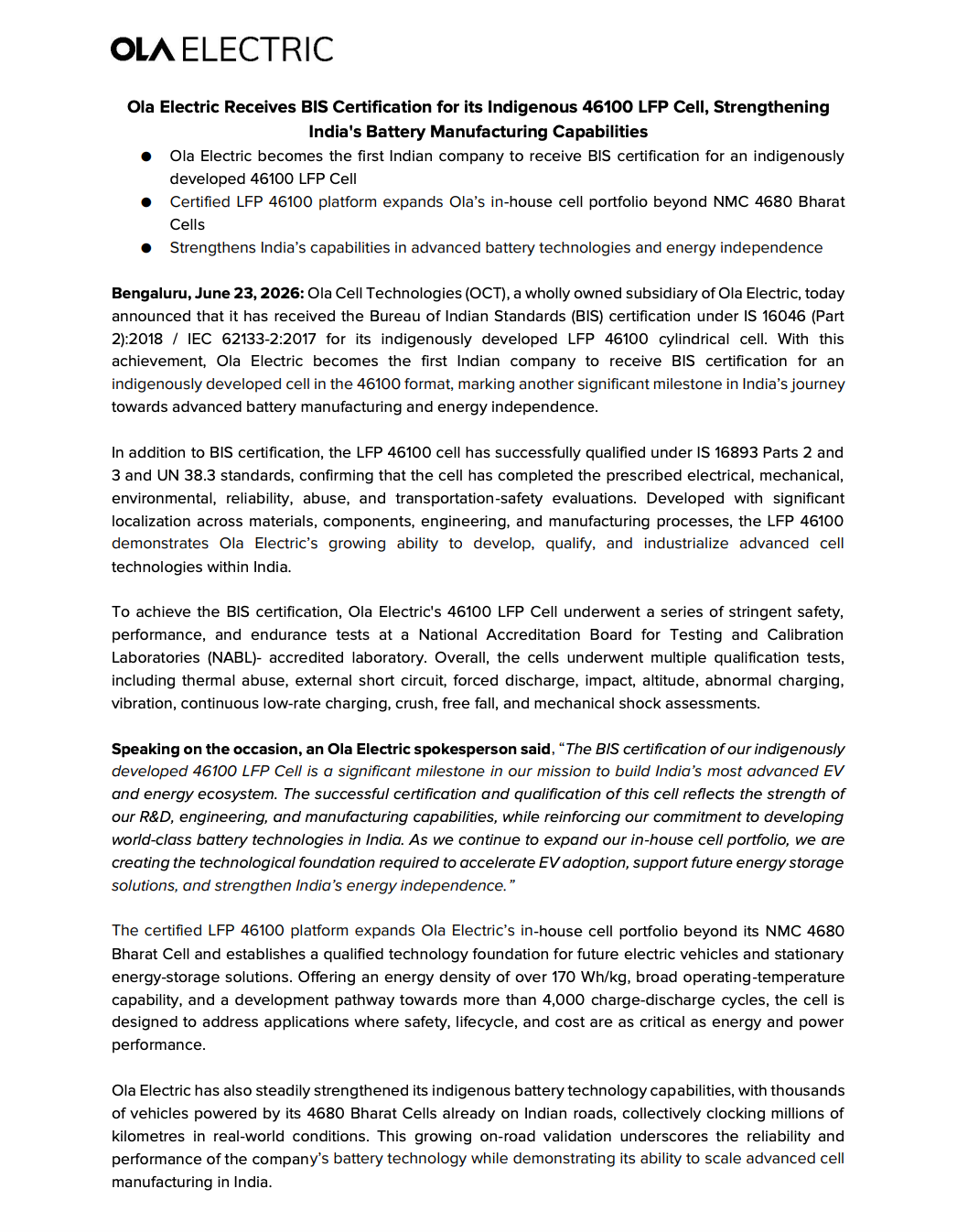
Ola Electric announced that its wholly owned subsidiary, Ola Cell Technologies, has received Bureau of Indian Standards (BIS) certification for its indigenously developed 46100 LFP cylindrical battery cell. The certification marks a significant milestone in the company’s battery manufacturing roadmap and expands its in-house cell portfolio beyond the existing Bharat Cell platform.
PRICE-SENSITIVE TRIGGER
Event: BIS Certification Received for Indigenous 46100 LFP Cell
Type: Technology & Product Development Milestone
Impact: Positive
Immediate Effect: The certification validates Ola Electric’s indigenous battery technology capabilities, strengthens its vertical integration strategy, and supports future deployment of domestically manufactured battery cells across mobility and energy storage applications.
Key Metrics:
- Certification Authority: Bureau of Indian Standards (BIS)
- Certified Product: 46100 LFP Cylindrical Cell
- Certification Standard: IS 16046 (Part 2):2018 / IEC 62133-2:2017
- Additional Qualifications: IS 16893 Parts 2 & 3, UN 38.3
- Cell Chemistry: Lithium Iron Phosphate (LFP)
- Energy Density: Over 170 Wh/kg
- Target Lifecycle: Development pathway beyond 4,000 charge-discharge cycles
Highlight:
- Key Milestone: First Indian company to receive BIS certification for an indigenously developed 46100-format LFP cell.
What Happened ?
Ola Cell Technologies (OCT), a wholly owned subsidiary of Ola Electric Mobility Limited, announced that it has received BIS certification for its indigenous 46100 LFP cylindrical battery cell.
According to the company, the certification makes Ola Electric the first Indian company to secure BIS approval for an indigenously developed cell in the 46100 format. The battery has also successfully qualified under IS 16893 Parts 2 and 3 and UN 38.3 standards, covering electrical, mechanical, environmental, reliability, abuse, and transportation safety requirements.
The announcement was made through a company press release submitted to stock exchanges on June 23, 2026.
Key Details
Battery Technology & Strategic Significance:
- The certified product is an indigenous 46100-format LFP cylindrical battery cell.
- Development was carried out through Ola Cell Technologies, a wholly owned subsidiary of Ola Electric.
- Certification was granted under BIS standard IS 16046 (Part 2):2018 / IEC 62133-2:2017.
- The cell completed qualification requirements under IS 16893 Parts 2 and 3 and UN 38.3 safety standards.
- Testing was conducted at a NABL-accredited laboratory across multiple safety and endurance parameters.
- Qualification tests included thermal abuse, external short circuit, forced discharge, impact, altitude, vibration, crush, free-fall, mechanical shock, and abnormal charging assessments.
- The certified platform expands Ola Electric’s in-house battery portfolio beyond its NMC 4680 Bharat Cell.
- The company intends to deploy both NMC and LFP technologies on a common 46-series battery architecture.
- The platform is designed for electric mobility as well as stationary energy-storage applications.
- Ola stated that thousands of vehicles powered by Bharat Cells are already operating on Indian roads, providing real-world validation of its battery technology.
Note:
- The certification represents an important step in Ola Electric’s strategy to localize battery manufacturing, reduce dependence on imported cell technologies, and build a fully integrated EV supply chain within India.
Risk Analysis
Summary:
- While the certification validates technology readiness and regulatory compliance, commercial benefits will depend on large-scale manufacturing execution, cost competitiveness, product reliability, and successful integration into future vehicle platforms.
Key Risks:
- Certification does not automatically translate into immediate revenue generation.
- Large-scale commercial production and yield optimization remain critical execution challenges.
- Battery technology development requires continued investment in R&D and manufacturing infrastructure.
- Competitive pressure from global cell manufacturers remains significant.
- Commercial adoption will depend on performance, lifecycle, safety, and cost competitiveness.
Worst Case:
- If commercial scaling, manufacturing efficiency, or product economics fail to meet expectations, the strategic benefits of the certified cell platform could take longer to materialize.
Risk Level: Medium
Company Commentary
- Ola Electric has become the first Indian company to receive BIS certification for an indigenously developed 46100 LFP cell.
- The certification is viewed as a major milestone in building India’s advanced EV and energy ecosystem.
- The company highlighted the strength of its R&D, engineering, and manufacturing capabilities.
- The certified platform expands Ola Electric’s in-house battery portfolio beyond the NMC 4680 Bharat Cell.
- The company aims to accelerate EV adoption, support energy-storage solutions, and strengthen India’s energy independence.
- Ola Electric continues to develop both NMC and LFP battery technologies under its Gigafactory strategy.
Official Exchange Filing: Ola Electric Mobility Limited