Quarterly Financial Results
Can Fin Homes Reports Q1 FY27 Results; PAT Rises 20% as Loan Book Grows 11% YoY
NSE
CANFINHOME
BSE
511196
- Can Fin Homes Limited reported a healthy start to FY27 with a 20% year-on-year increase in Profit After Tax (PAT) to ₹268 crore, supported by an 11% growth in loan assets and a 29% rise in loan disbursements.
- The company also maintained strong profitability ratios, healthy liquidity, and robust asset quality during the quarter ended June 30, 2026.
PRICE-SENSITIVE TRIGGER
Event: Q1 FY27 Financial Results Announcement
Type: Quarterly Financial Results
Impact: Positive
Immediate Effect: Higher profitability, sustained loan book expansion, improved lending activity, and strong liquidity reinforce Can Fin Homes’ stable operating performance and financial position.
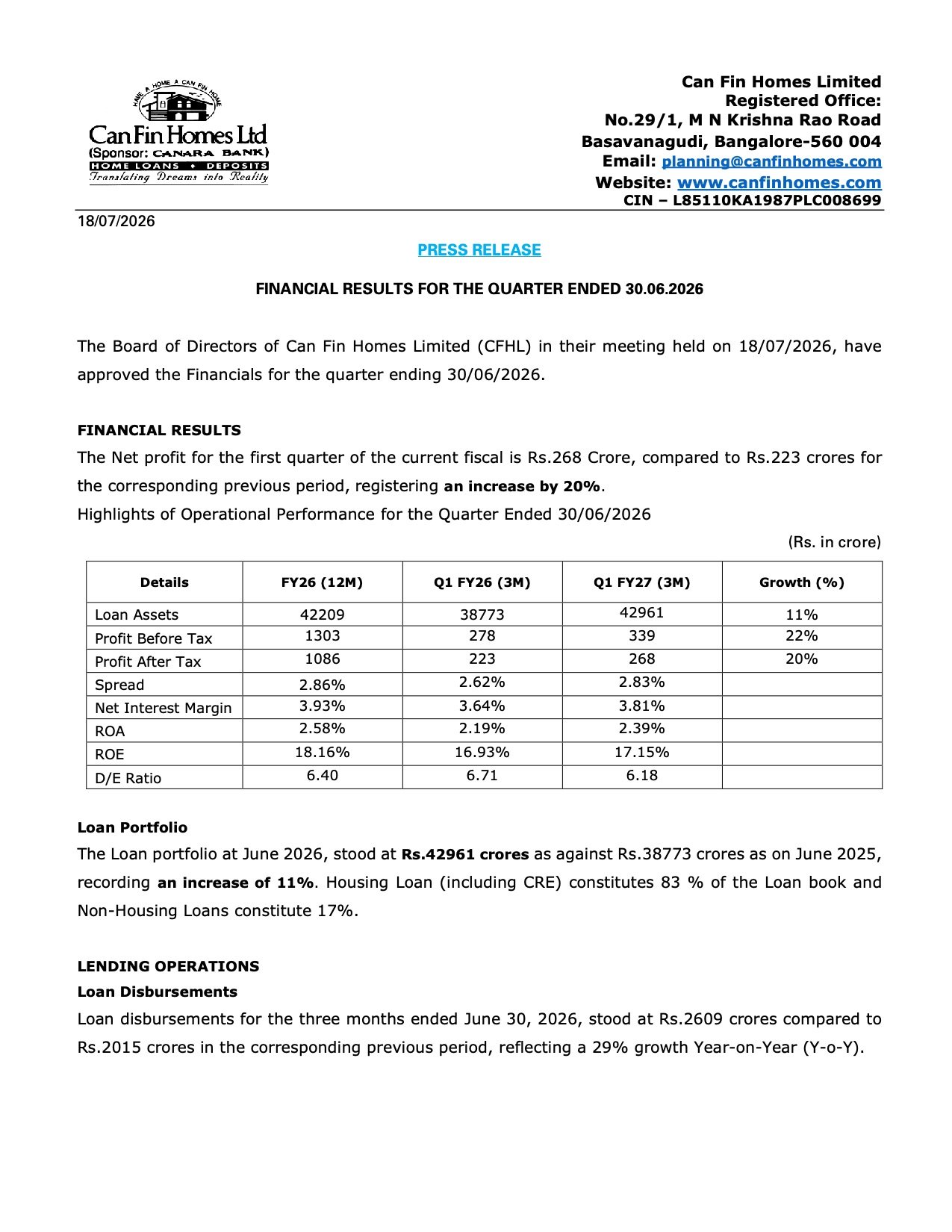
Metrics:
Loan Portfolio & Profitability:
- Loan Assets: ₹42,961 crore (+11% YoY)
- Profit Before Tax (PBT): ₹339 crore (+22% YoY)
- Profit After Tax (PAT): ₹268 crore (+20% YoY)
Lending & Margins:
- Loan Disbursements: ₹2,609 crore (+29% YoY)
- Spread: 2.83% (vs. 2.62% in Q1 FY26)
- Net Interest Margin (NIM): 3.81% (vs. 3.64% in Q1 FY26)
Return Ratios:
- Return on Assets (ROA): 2.39% (vs. 2.19% YoY)
- Return on Equity (ROE): 17.15% (vs. 16.93% YoY)
Capital & Leverage:
- Debt-to-Equity Ratio: 6.18x (improved from 6.71x in Q1 FY26)
Portfolio Mix:
- Housing Loans (including CRE): 83% of total loan book
- Non-Housing Loans: 17% of total loan book
Highlight:
- Can Fin Homes reported a 20% increase in Q1 FY27 net profit to ₹268 crore, driven by double-digit loan asset growth, stronger loan disbursements, improved spreads, and higher net interest margins.
What Happened ?
Can Fin Homes Limited announced its financial results for the quarter ended 30 June 2026, with the Board of Directors approving the quarterly financial statements at its meeting held on 18 July 2026. The company reported broad-based growth across its lending business, profitability, and operational metrics.
Loan assets increased to ₹42,961 crore, representing an 11% year-on-year growth, while loan disbursements rose 29%to ₹2,609 crore. Housing loans, including Commercial Real Estate (CRE), continued to dominate the portfolio, accounting for 83% of the total loan book.
Profitability strengthened during the quarter, with Profit Before Tax rising 22% to ₹339 crore and Profit After Tax increasing 20% to ₹268 crore. The company also reported an improvement in its lending spread, Net Interest Margin, Return on Assets, and Return on Equity, indicating continued operational efficiency.
The quarter also reflected prudent balance sheet management, with a lower debt-to-equity ratio and continued maintenance of adequate liquidity to support future lending commitments.
key details
Operational Performance:
Can Fin Homes delivered steady operational growth during Q1 FY27, supported by higher loan disbursements, expansion of its loan portfolio, and continued improvement in lending spreads. The company maintained its focus on retail housing finance while preserving profitability and operational discipline.
Key Operational Highlights
- Loan assets increased to ₹42,961 crore, registering 11% YoY growth.
- Loan disbursements rose to ₹2,609 crore, reflecting 29% YoY growth.
- Profit Before Tax increased by 22% to ₹339 crore.
- Profit After Tax grew 20% to ₹268 crore.
- Lending spread improved to 2.83%, compared with 2.62% in the corresponding quarter last year.
- Net Interest Margin expanded to 3.81%, supporting overall profitability.
Loan Portfolio:
Can Fin Homes continued to expand its housing finance portfolio while maintaining a balanced asset mix.
Portfolio Growth
- Total Loan Assets: ₹42,961 crore.
- Housing Loans (including Commercial Real Estate): 83% of the loan portfolio.
- Non-Housing Loans: 17% of the loan portfolio.
The continued dominance of housing loans reflects the company’s core business strategy while selective diversification into non-housing loans provides additional growth opportunities.
Lending Operations:
The company recorded strong growth in loan disbursements during the quarter, indicating healthy credit demand and continued execution of its lending strategy.
Lending Highlights
- Loan disbursements increased from ₹2,015 crore in Q1 FY26 to ₹2,609 crore in Q1 FY27.
- Disbursement growth of 29% YoY outpaced the overall growth in loan assets.
- Growth was driven by continued demand across the housing finance segment.
Liquidity & Provisioning:
Can Fin Homes maintained a strong liquidity position while carrying provisions well above the regulatory requirement under Ind AS 109.
Liquidity Position
- Liquidity Coverage Ratio (LCR): 250.32%, significantly above the regulatory requirement of 100%.
- Undrawn Bank Lines: ₹1,524.55 crore as of 30 June 2026.
- Internal accruals and available bank limits are expected to adequately support business commitments over the next three months.
Expected Credit Loss (ECL) Provisions
- Required ECL Provision (Ind AS 109): ₹410 crore.
- Total Provision Maintained: ₹509 crore.
- Management Overlay: ₹59 crore.
- Provision for Restructured Accounts: ₹40 crore.
The higher provision buffer demonstrates a conservative provisioning approach and enhances the company’s resilience against potential credit stress.
Deposit Business & Credit Ratings:
The company continued to strengthen its deposit franchise while maintaining the highest credit ratings for its borrowing programmes.
Deposit Highlights
- Deposit portfolio stood at ₹227.09 crore.
- 36-month cumulative deposits offer an interest rate of 7.50%.
- Senior citizens receive an additional 0.25% interest rate.
Credit Ratings
- Fixed Deposit Programme: Rated AAA (Stable Outlook) by ICRA.
- Commercial Papers: Rated A1+ by CARE and ICRA.
- Long-Term Debt & Subordinated Debt: Rated AAA (Stable) by CARE and ICRA.
The reaffirmed highest credit ratings reflect the company’s strong credit profile and funding quality.
Retail Network & Technology Development:
Can Fin Homes continued investing in operational capabilities while expanding its nationwide presence.
Network Expansion
- Presence across 250 branches/offices.
- Operations span 21 States and Union Territories, providing broad geographic coverage.
Technology Initiatives
- Successfully completed the pilot implementation of its new IBM-led Core Banking Solution across five branches.
- The new platform demonstrated stable performance during the pilot phase.
- The implementation is expected to enhance operational efficiency, improve scalability, and optimise cost structures as deployment expands across the network.
Why It Matters:
The Q1 FY27 performance highlights Can Fin Homes’ ability to balance business growth with prudent risk management and operational efficiency.
Key Investor Takeaways
- Double-digit loan asset growth and higher disbursements indicate continued demand for housing finance.
- Improvement in lending spreads and Net Interest Margin supports sustainable earnings growth.
- Strong liquidity and provisioning buffers strengthen the company’s financial resilience.
- Highest credit ratings facilitate access to diversified and cost-effective funding sources.
- Nationwide branch network and ongoing digital transformation position the company for scalable long-term growth.
- A housing-focused portfolio with disciplined underwriting continues to support stable asset quality and consistent profitability.
Risk Analysis
Summary:
- Can Fin Homes delivered a healthy Q1 FY27 performance with growth in loan assets, profitability, and lending activity while maintaining a strong liquidity position and conservative provisioning. Although the company remains well-capitalised and operationally resilient, future performance will continue to depend on sustaining credit growth, preserving asset quality, and managing funding costs in a changing interest rate environment.
Key Risks:
- Interest Rate Risk: Changes in market interest rates may impact borrowing costs, lending spreads, and Net Interest Margin.
- Credit Risk: Continued expansion of the loan portfolio requires maintaining disciplined underwriting standards to preserve asset quality.
- Housing Market Risk: A slowdown in residential real estate demand could affect loan disbursements and future portfolio growth.
- Liquidity Risk: Although current liquidity remains strong, maintaining adequate funding at competitive costs will remain important for business expansion.
- Regulatory Risk: Changes in RBI or NHB regulations governing housing finance companies could influence lending practices, provisioning norms, or capital management.
- Execution Risk: Successful organisation-wide implementation of the new IBM-led Core Banking Solution will be important to realise expected operational efficiencies.
Worst Case:
- A combination of weaker housing demand, higher funding costs, and deterioration in borrower repayment behaviour could slow loan growth, compress margins, and increase provisioning requirements, affecting future profitability.
Risk Level: Low
Company Commentary
Based on the company’s Q1 FY27 press release, management highlighted the following developments:
- The Board of Directors approved the financial results for the quarter ended 30 June 2026.
- Net Profit increased to ₹268 crore, representing 20% year-on-year growth.
- Loan assets expanded to ₹42,961 crore, supported by 29% growth in loan disbursements.
- The company continues to maintain a strong liquidity position, with a Liquidity Coverage Ratio of 250.32%, significantly above the regulatory requirement.
- Total Expected Credit Loss provisions of ₹509 crore exceed the required provisioning under Ind AS 109, reflecting a prudent risk management approach.
- The company retained the highest credit ratings for its Fixed Deposit programme, Commercial Papers, and Long-Term Debt instruments.
- The successful pilot rollout of the IBM-led Core Banking Solution across five branches marks an important milestone in the company’s technology transformation aimed at enhancing operational efficiency and scalability.
Official Exchange Filing: Can Fin Homes Limited