Price Increase
Maruti Suzuki to Increase Vehicle Prices by Up to ₹30,000 from August 2026 Amid Rising Input Costs
NSE
maruti
BSE
532500
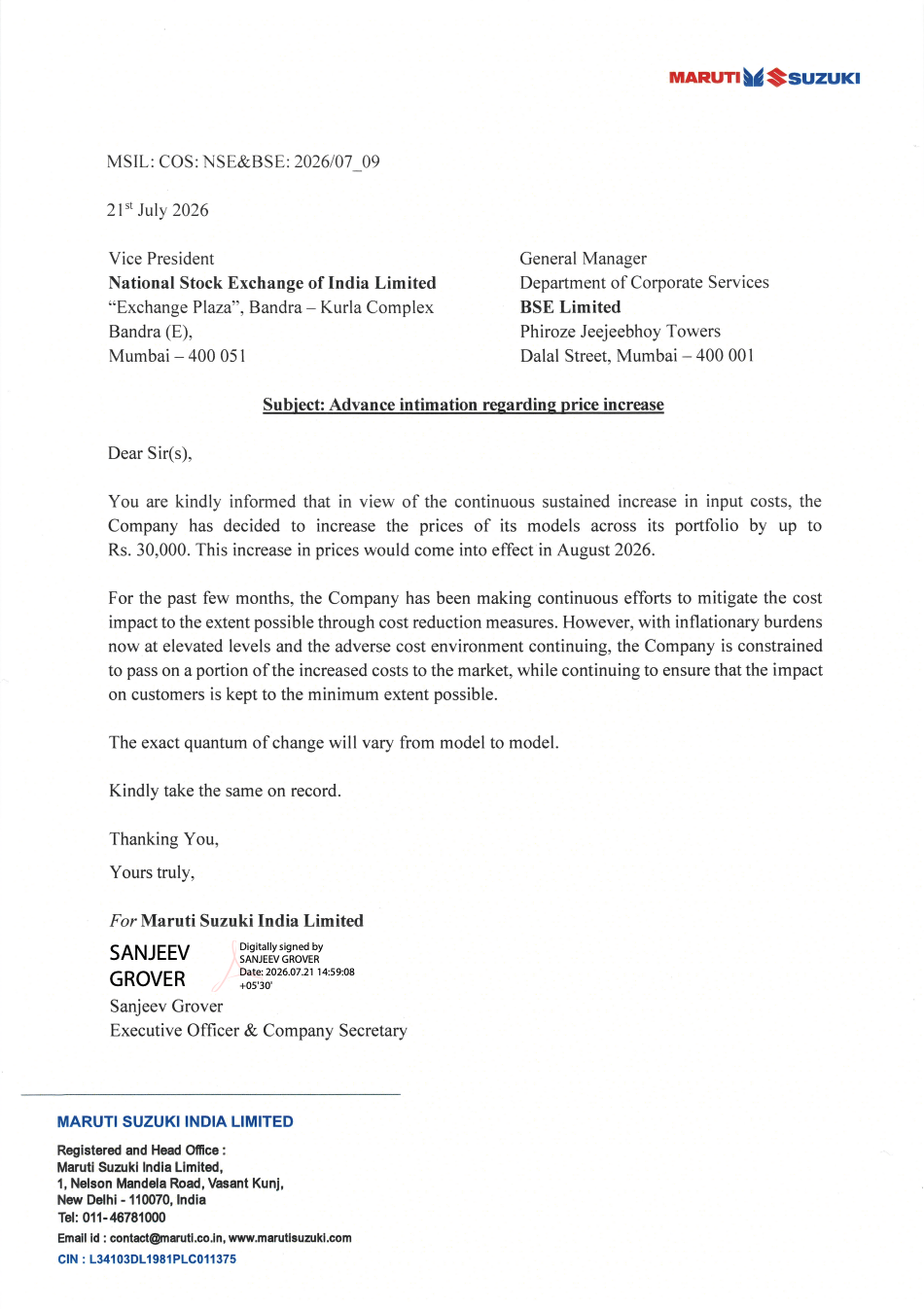
- Maruti Suzuki India Limited (MSIL) has announced a price increase of up to ₹30,000 across its vehicle portfolio, effective August 2026, citing a sustained rise in input costs and inflationary pressures.
- The company stated that despite implementing various cost reduction measures over the past few months, rising costs have necessitated passing on a portion of the burden to customers. The exact increase will vary across different models.
PRICE-SENSITIVE TRIGGER
Event: Maruti Suzuki informed the stock exchanges that it will increase prices across its model portfolio from August 2026.
Type: Price Increase
Impact: Positive
Immediate Effect: The price revision is expected to partially offset rising input costs and help protect operating margins amid persistent inflationary pressures.
Metrics:
Key Announcement:
- Maximum Price Increase: Up to ₹30,000
- Effective From: August 2026
- Applicable To: Entire Maruti Suzuki model portfolio
- Reason: Sustained increase in input costs and inflationary pressures
- Model-wise Impact: Price increase will vary depending on the vehicle model.
Highlight:
- The company is implementing a portfolio-wide price revision after exhausting internal cost-saving initiatives to mitigate rising production costs.
What Happened ?
Maruti Suzuki announced that it will revise the prices of its passenger vehicles across its entire product portfolio from August 2026.
According to the company, the decision follows a prolonged increase in input costs and a challenging cost environment. While Maruti Suzuki has undertaken continuous cost optimization initiatives to absorb these increases, it stated that a partial pass-through has become necessary to maintain business sustainability.
The company emphasized that the impact on customers will be kept to the minimum possible extent, with the exact price revision differing by model.
key details
Price Revision:
- Vehicle prices will increase by up to ₹30,000.
- The revised prices will become effective from August 2026.
- The increase applies across the company’s entire passenger vehicle portfolio.
- The exact quantum of increase will differ from one model to another.
Reason for the Price Increase:
- Continuous increase in raw material and input costs.
- Elevated inflationary pressures affecting manufacturing costs.
- Persistent adverse cost environment across the automotive industry.
- Rising production expenses that could no longer be fully absorbed internally.
Note:
- The company stated that despite sustained cost-control initiatives, it has become necessary to pass on a portion of the increased costs to the market.
Cost Optimization Measures:
Before announcing the price revision, Maruti Suzuki undertook several initiatives to minimize the impact of rising costs, including:
- Continuous cost reduction efforts.
- Operational efficiency improvements.
- Measures aimed at absorbing higher input costs internally.
Note:
- Management indicated that these initiatives helped delay a price increase, but prolonged inflationary pressures eventually required partial cost pass-through.
Customer Impact:
- The company intends to minimize the impact on customers.
- Price revisions will vary by vehicle model rather than applying a uniform increase.
- Customers purchasing vehicles before the effective date may avoid the revised pricing, subject to dealer terms and delivery schedules.
Business Implications:
- The price increase is expected to support profitability by partially offsetting higher manufacturing costs.
- The revision reflects continued cost discipline while preserving long-term financial stability.
- Pricing actions remain an important tool for managing inflationary pressures in the automotive industry.
Risk Analysis
Summary:
- The price increase is expected to improve cost recovery; however, higher vehicle prices could influence customer demand depending on market conditions and competitive pricing across the passenger vehicle industry.
Key Risks:
- Higher prices may affect demand in price-sensitive vehicle segments.
- Competitive responses from other automobile manufacturers could influence market share.
- Continued inflation in raw material costs may require additional pricing actions.
- Consumer sentiment and financing costs remain important factors for vehicle demand.
Worst Case:
- If consumer demand weakens significantly following the price revision or inflationary pressures continue to intensify, the company may face pressure on sales volumes despite improved per-unit realizations.
Risk Level: Low
Company Commentary
- Maruti Suzuki stated that the decision follows a sustained increase in input costs and an adverse cost environment.
- The company highlighted that it has made continuous efforts to reduce costs internally over the past several months.
- Management emphasized that only a portion of the increased costs is being passed on to customers.
- The exact price increase will vary across different models, with efforts made to minimize the impact on customers.
Official Exchange Filing: Maruti Suzuki India Limited