Order Wins / Contract Awards
Apollo Micro Systems Secures Indian Navy Make-II Prototype Sanction Order for SAVIOR-ASW Autonomous Underwater Surveillance System
NSE
apollo
BSE
540879
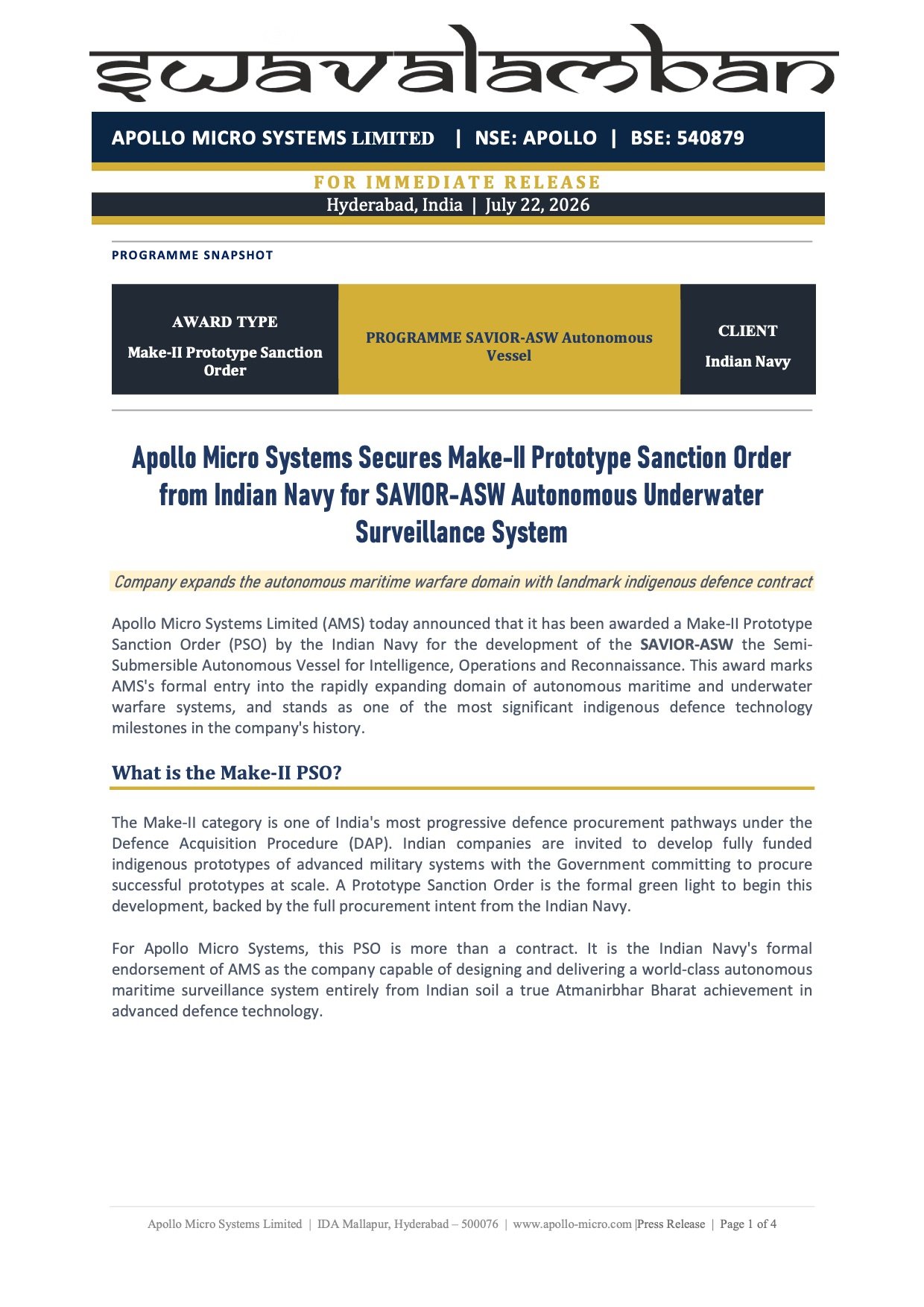
- Apollo Micro Systems Limited has secured a Make-II Prototype Sanction Order (PSO) from the Indian Navy for the design, development and prototype demonstration of SAVIOR-ASW (Semi-Submersible Autonomous Vessel for Intelligence, Operations and Reconnaissance).
- The project marks the company’s entry into autonomous maritime and underwater warfare systems and represents one of the most significant indigenous defence technology milestones in its history.
- The programme aligns with India’s Atmanirbhar Bharat initiative and positions Apollo Micro Systems in the rapidly growing autonomous maritime defence segment.
PRICE-SENSITIVE TRIGGER
Event: Apollo Micro Systems announced that it has been awarded a Make-II Prototype Sanction Order (PSO) by the Indian Navy for the development of the SAVIOR-ASW Autonomous Underwater Surveillance System.
Type: Order Wins / Contract Awards
Impact: Positive
Immediate Effect:
- The sanction order authorises Apollo Micro Systems to begin development of the indigenous prototype under the Defence Acquisition Procedure (DAP) Make-II framework.
- The project strengthens the company’s presence in India’s strategic defence ecosystem and creates an opportunity to participate in future procurement programmes upon successful prototype demonstration.
What Happened ?
Apollo Micro Systems has been selected by the Indian Navy to design and develop SAVIOR-ASW, India’s first indigenously developed semi-submersible autonomous vessel specifically built for Anti-Submarine Warfare (ASW)surveillance. The unmanned platform is designed to conduct persistent underwater surveillance using advanced hydrophone arrays while autonomously transmitting intelligence to naval command centres.
The company stated that the Prototype Sanction Order represents the Indian Navy’s formal recognition of Apollo Micro Systems’ indigenous defence capabilities and its ability to develop advanced autonomous maritime surveillance systems. Successful completion of the programme could position the company for future procurement opportunities as India expands its indigenous underwater warfare capabilities.
Key Highlights:
- Awarded a Make-II Prototype Sanction Order by the Indian Navy.
- Project covers the development of the SAVIOR-ASW Autonomous Underwater Surveillance System.
- Marks Apollo Micro Systems’ formal entry into autonomous maritime and underwater warfare.
- Supports India’s Atmanirbhar Bharat initiative in defence manufacturing.
- Strengthens the company’s position in indigenous defence electronics and mission-critical systems.
- Creates long-term opportunities in India’s next-generation naval modernisation programmes.
key details
Make-II Programme Framework:
The project has been sanctioned under the Make-II category of India’s Defence Acquisition Procedure (DAP), a framework that promotes indigenous design and development of advanced defence systems by the private sector. A Prototype Sanction Order (PSO) authorises Apollo Micro Systems to begin prototype development, with procurement envisaged upon successful completion and acceptance by the Indian Navy.
Key Highlights:
- Award received under the Make-II category of the Defence Acquisition Procedure.
- Prototype development will be undertaken by Apollo Micro Systems.
- The Government bears no financial obligation during the prototype development phase.
- Successful prototype demonstration is expected to lead to procurement under the Make-II policy.
- The programme supports indigenous defence manufacturing and technological self-reliance.
SAVIOR-ASW Technology:
The SAVIOR-ASW (Semi-Submersible Autonomous Vessel for Intelligence, Operations and Reconnaissance) is India’s first indigenously developed semi-submersible autonomous vessel designed specifically for Anti-Submarine Warfare (ASW) surveillance.
Operating without onboard human intervention, the vessel is designed to conduct persistent underwater surveillance by detecting submarine activity and transmitting intelligence to naval command centres in real time.
Key Capabilities
- Semi-submersible autonomous maritime platform.
- Designed for persistent Anti-Submarine Warfare (ASW) surveillance.
- Operates autonomously for extended durations.
- Equipped with advanced hydrophone arrays for underwater threat detection.
- Uses AI-enabled processing for intelligence gathering.
- Securely transmits surveillance data to naval command centres ashore and onboard ships.
- Fully indigenous design supporting India’s strategic defence capabilities.
Strategic Importance:
The company highlighted that the Indian Ocean Region (IOR) has become one of the world’s most strategically significant maritime corridors, increasing the need for persistent underwater surveillance capabilities.
Key Industry Statistics:
- Around 95% of India’s trade by volume moves through sea routes.
- Nearly 68% of India’s trade by value is transported by sea.
- Approximately 100,000 merchant vessels transit the Indian Ocean annually.
- Nearly 30% of global containerised cargo passes through the Indian Ocean Region.
- Around 42% of the world’s crude oil trade moves through the region.
The increasing deployment of submarines and underwater threats has made continuous maritime surveillance a strategic priority for safeguarding sea lanes, ports and critical maritime infrastructure.
Operational Advantages:
Apollo Micro Systems stated that autonomous maritime platforms can significantly improve surveillance efficiency while reducing lifecycle costs compared with conventional naval assets.
Key Benefits:
- Enables continuous autonomous underwater surveillance.
- Covers wider maritime areas using multiple autonomous platforms.
- Reduces dependence on expensive frontline ASW frigates for routine surveillance.
- Optimises deployment of high-value naval assets for strategic missions.
- Improves maritime domain awareness while lowering long-term operating costs.
- Provides persistent monitoring at a fraction of the acquisition and maintenance cost of conventional warships.
Market Opportunity:
The company believes autonomous maritime systems represent one of the fastest-growing segments within the global defence industry and expects significant long-term demand for such technologies.
Key Highlights
- Estimated global autonomous maritime systems market opportunity of approximately US$10 billion by 2032.
- Addressable opportunities extend across multiple defence customers and international markets.
- The estimate is based on publicly available information and remains subject to future government procurement decisions.
Long-Term Business Strategy:
Apollo Micro Systems views autonomous maritime warfare as a major future growth area and intends to leverage its defence electronics expertise to build next-generation indigenous naval technologies.
Strategic Focus Areas
- Develop autonomous maritime surveillance platforms.
- Expand AI-enabled defence and mission-critical systems.
- Build autonomous swarm capabilities for coordinated maritime operations.
- Strengthen AI-driven intelligence and sensor processing.
- Deliver persistent, affordable surveillance solutions for modern naval forces.
- Scale indigenous defence technologies for future domestic and international opportunities.
Risk Analysis
Summary:
- The Make-II Prototype Sanction Order is a significant strategic milestone for Apollo Micro Systems, expanding its presence into autonomous maritime and underwater warfare. However, the project remains in the prototype development phase, and its commercial value will depend on successful execution, acceptance by the Indian Navy and subsequent procurement under the Make-II framework.
Key Risks:
- Prototype Execution Risk: Successful completion of the design, development and demonstration phase is required before the programme can move to procurement.
- Revenue Visibility Risk: The company has not disclosed the order value or expected financial contribution, limiting visibility on near-term earnings impact.
- Procurement Risk: Government procurement is contingent upon successful prototype acceptance and future procurement decisions under the Defence Acquisition Procedure.
- Technology Development Risk: The project involves advanced autonomous navigation, underwater surveillance, AI-enabled intelligence processing and mission-critical defence technologies that require successful integration and validation.
- Programme Timeline Risk: Defence projects typically involve rigorous testing, certification and evaluation, which could affect execution timelines.
- Market Opportunity Risk: While the company estimates a US$10 billion autonomous maritime systems opportunity by 2032, actual business potential will depend on future defence spending, competitive positioning and procurement decisions.
Worst Case:
- If the prototype does not successfully meet the Indian Navy’s operational requirements or future procurement plans are delayed or revised, the programme may not convert into commercial production orders, limiting its financial contribution despite its strategic importance.
Risk Level: Medium
Company Commentary
Managing Director Karunakar Reddy Baddam described the award as a defining moment in Apollo Micro Systems’ journey, stating that it reflects years of investment in indigenous defence electronics and mission-critical systems. He said the SAVIOR-ASW programme represents the company’s commitment to building technologies that strengthen India’s sovereign maritime capabilities and position the country for the future of autonomous, intelligent and networked warfare.
He also acknowledged the contribution of DRDO, noting that the organisation’s programmes helped build the knowledge base for developing complex underwater warfare technologies, while highlighting that several critical technology building blocks have already been developed and configured by Apollo Micro Systems.
Management Priorities
- Successfully develop and demonstrate the SAVIOR-ASW prototype.
- Strengthen India’s indigenous underwater warfare capabilities.
- Expand leadership in autonomous maritime defence technologies.
- Advance AI-driven and network-centric defence systems.
- Support the Atmanirbhar Bharat initiative through indigenous innovation.
- Scale advanced defence technologies for future naval programmes and broader market opportunities.
Official Exchange Filing: Apollo Micro Systems Limited