Credit Rating Update
UCO Bank Receives First-Time Fitch ‘BBB-’ Rating with Stable Outlook; Agency Highlights Strong Government Support
NSE
ucobank
BSE
532505
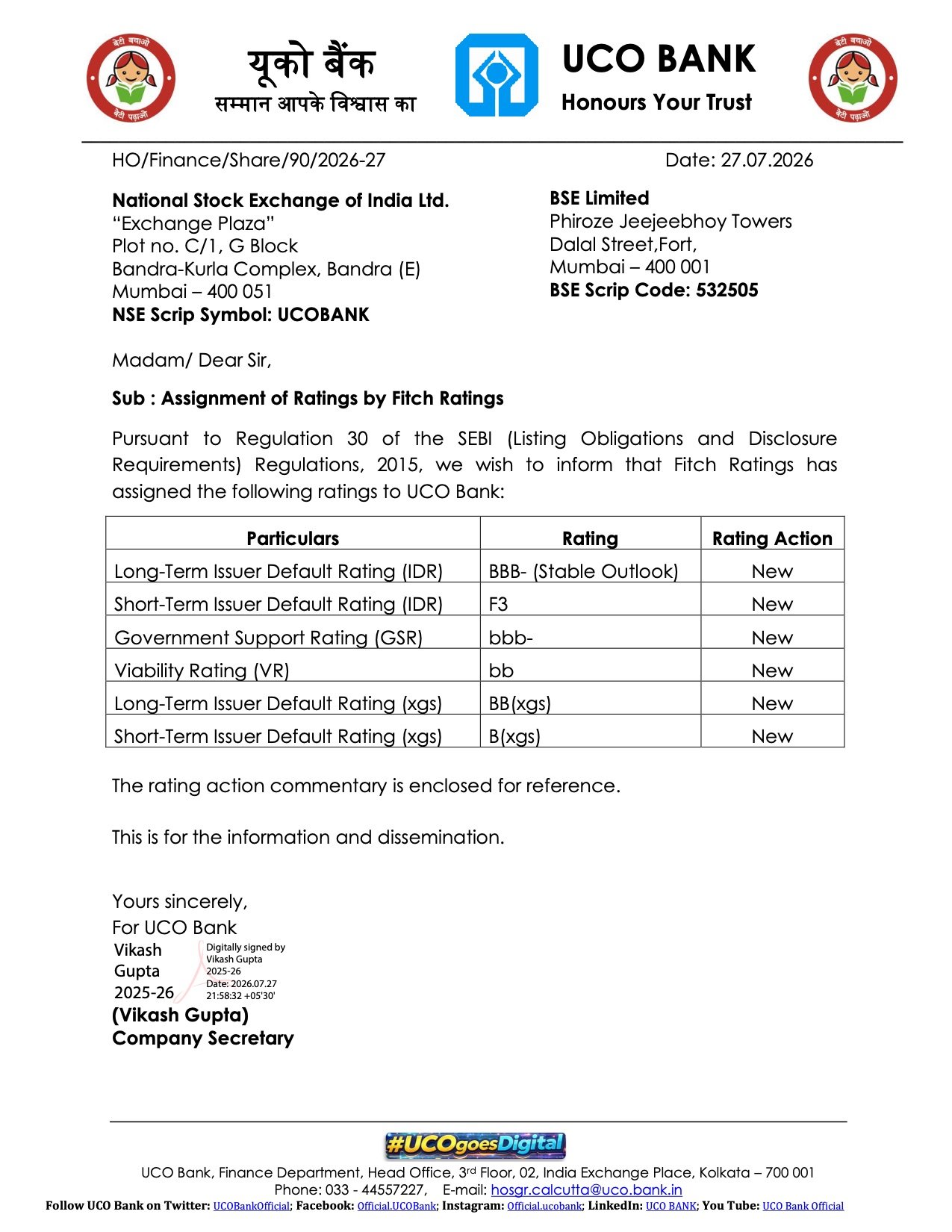
- UCO Bank announced that Fitch Ratings has assigned its first international credit ratings, including a Long-Term Issuer Default Rating (IDR) of ‘BBB-’ with a Stable Outlook.
- Fitch also assigned a Short-Term IDR of ‘F3’, Government Support Rating (GSR) of ‘bbb-’, and Viability Rating (VR) of ‘bb’.
- The rating agency cited the bank’s strong government ownership, improving financial profile, better asset quality and robust capital position as key strengths.
PRICE-SENSITIVE TRIGGER
Event: Assignment of First-Time Fitch Credit Ratings
Type: Credit Rating Update
Impact: Positive
Immediate Effect: The first-time investment-grade international issuer rating enhances UCO Bank’s global credit profile and reflects Fitch’s confidence in continued government support and improving standalone financial performance.
Metrics:
Key Financial Metrics:
- Long-Term Issuer Default Rating (IDR): BBB- (Stable Outlook) (New Rating)
- Short-Term Issuer Default Rating (IDR): F3 (New Rating)
- Government Support Rating (GSR): bbb- (New Rating)
- Viability Rating (VR): bb (New Rating)
- Long-Term Issuer Default Rating (xgs): BB(xgs) (New Rating)
- Short-Term Issuer Default Rating (xgs): B(xgs) (New Rating)
Highlight:
- Fitch assigned UCO Bank its first-ever ‘BBB-’ Long-Term Issuer Default Rating with a Stable Outlook, aligning the bank’s long-term rating with India’s sovereign rating due to the high probability of government support.
What Happened ?
UCO Bank informed the stock exchanges that Fitch Ratings has assigned the bank its inaugural international credit ratings.
According to Fitch, the Long-Term IDR of ‘BBB-’ is driven primarily by the Government of India’s 91% ownership in UCO Bank and the agency’s expectation that the government would provide timely support if required. Consequently, the Stable Outlook on the bank mirrors the Stable Outlook assigned to India’s sovereign rating.
Alongside government support, Fitch acknowledged that UCO Bank has significantly strengthened its financial profile over the past few years through improvements in asset quality, profitability, capital adequacy and risk management practices.
key details
Why Fitch Assigned the Rating:
Fitch highlighted several key strengths supporting the ratings:
Strong Government Backing
- Government of India holds approximately 91% stake in UCO Bank.
- Fitch believes there is a high probability of extraordinary government support if required.
- The Long-Term IDR is equalised with India’s sovereign rating because of this support expectation.
Improving Operating Environment:
Fitch expects India’s banking sector to benefit from:
- Strong economic growth above 6% through FY27 and FY28.
- Better banking regulation and supervision by the Reserve Bank of India.
- Continued improvement in sector-wide financial performance.
Strengthening Financial Profile:
The rating agency noted that UCO Bank has demonstrated sustained improvement in:
- Asset quality.
- Capitalisation.
- Profitability.
- Risk management.
- Core operating performance.
Healthy Retail Loan Mix:
Fitch highlighted the bank’s diversified lending portfolio:
- Retail, Agriculture and MSME (RAM) loans account for 58% of total advances.
- Branch network of around 3,400 branches supports granular loan growth.
- Strong presence across eastern and northern India.
Asset Quality Continues to Improve:
Key observations include:
- Gross impaired loan ratio declined to 2.2% in FY26 from 2.7% in FY25.
- Loan loss coverage remains strong at around 88%.
- Credit quality is expected to remain broadly stable through FY28.
Strong Capital Position:
Fitch also highlighted the bank’s healthy capitalisation:
- CET1 Ratio increased to 16.4% in FY26.
- Capital ratios are expected to remain above 15% over the next two years despite continued loan growth.
Stable Funding Profile:
According to Fitch:
- Deposits account for nearly 88% of total funding.
- CASA and other low-cost deposits comprise around 36% of deposits.
- Liquidity Coverage Ratio (LCR) stood at 114%.
- Net Stable Funding Ratio (NSFR) stood at 127%, indicating comfortable liquidity.
Risk Analysis
Summary:
- While Fitch assigned an investment-grade issuer rating with a Stable Outlook, it noted that UCO Bank’s standalone viability remains linked to maintaining strong asset quality, prudent risk management and sustainable profitability.
Key Risks:
- Faster-than-expected loan growth could increase credit risk.
- Weakening asset quality may pressure standalone ratings.
- Changes in India’s sovereign rating could directly affect the bank’s Long-Term IDR.
- Economic shocks or prolonged inflationary pressures could impact the banking sector.
Worst Case:
- If sovereign support expectations weaken or UCO Bank’s financial profile deteriorates materially due to rising bad loans or weaker capital buffers, Fitch could revise the ratings downward.
Risk Level: Medium
Company Commentary
- UCO Bank informed the exchanges that Fitch Ratings has assigned the above ratings and enclosed the detailed rating rationale for investor reference.
- The bank stated that the disclosure has been made in accordance with Regulation 30 of the SEBI (Listing Obligations and Disclosure Requirements) Regulations, 2015.
Official Exchange Filing: UCO Bank Limited