Business Update & Investor Communication
Ola Electric Says Heavy Build Phase is Over; Focus Shifts to Margin Recovery and Scale-Up
NSE
olaelec
BSE
544225
Ola Electric Mobility Limited released a shareholder communication outlining its operational turnaround progress, cost reduction initiatives, EV market leadership, and Gigafactory scale-up plans. The company highlighted sequential improvement in EBITDA, gross margins, service quality, and battery manufacturing integration while positioning FY27 as a year focused on disciplined scale and operating leverage.
PRICE-SENSITIVE TRIGGER
Event: Ola Electric issued a shareholder communication providing updates on operational performance, profitability improvement, battery manufacturing progress, and FY27 strategic priorities.
Type: Business Update & Investor Communication
Impact: Positive
Immediate Effect: Ola Electric reported sharp improvement in gross margins, EBITDA trajectory, service metrics, and Gigafactory execution while guiding toward stronger operating leverage and scale recovery in FY27.
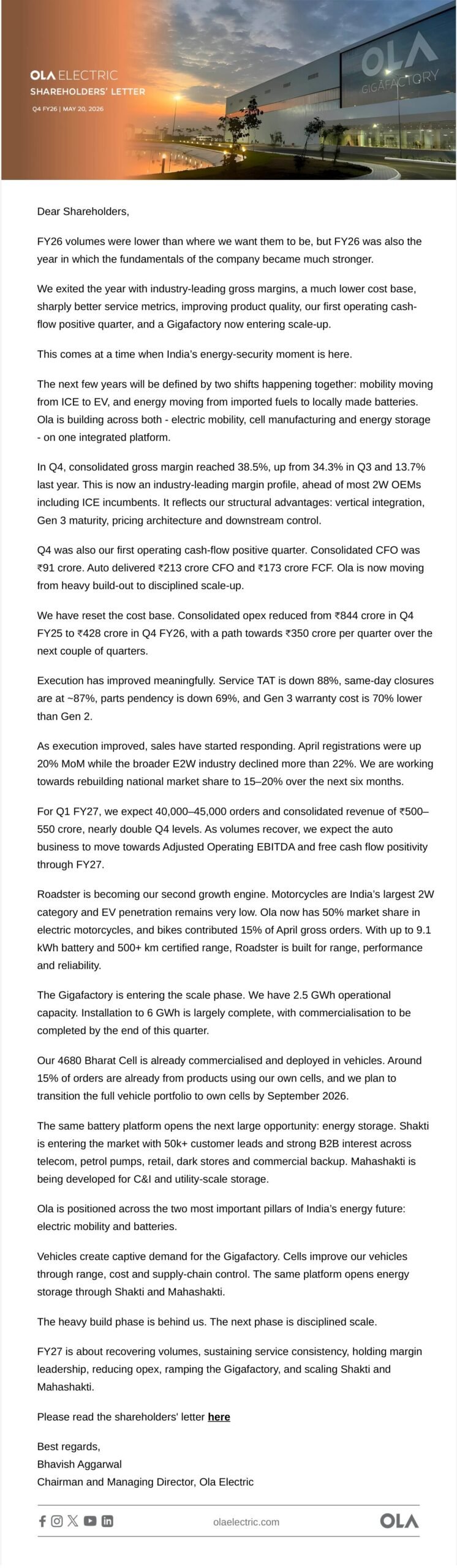
Key Metrics:
- Q4 FY26 Auto Gross Margin: 38.5%.
- Q4 FY26 Consolidated Gross Margin: 34.3%.
- Q4 FY26 Consolidated EBITDA Margin: Improved by approximately 850 bps QoQ.
- Q4 FY26 Consolidated Auto EBITDA: Improved by ₹428 crore QoQ.
- Q4 FY26 Consolidated Auto EBITDA: Reduced to approximately ₹350 crore loss.
- Q4 FY26 Consolidated Auto Free Cash Flow: Positive ₹173 crore.
- Q4 FY26 Consolidated Cash Flow: Positive ₹91 crore.
- April 2026 EV Registration Growth: Up over 20% MoM.
- Expected Industry Demand Recovery: 15%-20% growth over next six months.
- Ola EV Market Share: 50%+ in electric motorcycles and EV penetration segments.
- Gigafactory Operational Capacity: 2.5 GWh.
- Planned Gigafactory Capacity Installation: 6 GWh nearing completion.
- Cell Manufacturing Platform: Bharat Cell.
- Current Vehicle Integration from Own Cells: Around 15%.
- Battery Cell Energy Density: 4680 Bharat Cell commercialized.
- Vehicle Architecture: Gen 3 platform.
- Service TAT Reduction: Down 88%.
- Same-Day Service Closures: Above 87%.
- Pending Service Cases: Reduced by 60%.
- Gen 3 Warranty Cost Reduction: Approximately 70%.
Highlight Metric:
- Ola Electric reported sharp sequential improvement in EBITDA, delivered positive auto free cash flow of ₹173 crore in Q4 FY26, and highlighted significant operating leverage gains driven by cost reductions and vertical integration.
What Happened ?
Ola Electric released a shareholder communication highlighting operational progress achieved during FY26 despite lower-than-expected volumes.
The company stated that FY26 became a foundational year for long-term ecosystem development, with significant progress across EV manufacturing, battery cell production, software integration, and cost optimization initiatives.
Ola highlighted that Q4 FY26 marked its fourth consecutive quarter of gross margin expansion. Consolidated auto EBITDA improved significantly during the quarter, while the business delivered positive free cash flow.
Management stated that operational execution metrics improved materially, with lower service turnaround time, reduced pending cases, and lower warranty costs under the Gen 3 platform architecture.
The company also emphasized progress in battery manufacturing through its Gigafactory initiative and Bharat Cell commercialization program. Around 15% of vehicle production is already utilizing in-house battery cells, with full portfolio transition expected by September 2026.
Ola Electric indicated that the “heavy build phase” is now largely complete and FY27 will focus on disciplined scale-up, operating leverage, margin expansion, and Gigafactory ramp-up.
Key Details
Operational & Profitability Improvements:
- Q4 FY26 marked the fourth consecutive quarter of gross margin expansion.
- Auto gross margin improved to 38.5% during Q4 FY26.
- Consolidated gross margin reached 34.3%.
- Consolidated EBITDA improved by approximately 850 basis points QoQ.
- Auto EBITDA losses reduced substantially during the quarter.
- The company generated positive auto free cash flow of ₹173 crore.
- Consolidated free cash flow stood at positive ₹91 crore.
- Cost reduction initiatives significantly lowered operating expenses.
- Service turnaround time reduced by 88%.
- Same-day service closures improved to over 87%.
- Pending service requests declined by approximately 60%.
- Gen 3 warranty costs reduced by nearly 70%.
Note:
- The company is increasingly focusing on operational efficiency, cost optimization, and execution discipline rather than aggressive expansion spending.
Gigafactory & Battery Manufacturing Progress:
- Ola’s Gigafactory currently operates at 2.5 GWh capacity.
- Installation toward 6 GWh capacity is largely complete.
- Commercialization is expected before the end of the current quarter.
- The company commercialized its 4680 Bharat Cell platform.
- Around 15% of vehicles already use internally manufactured battery cells.
- Ola expects full portfolio transition to in-house cells by September 2026.
- Vertical integration is expected to improve margins and supply chain control.
- The battery platform also supports energy storage business opportunities.
Note:
- Battery localization and vertical integration remain central to Ola’s long-term margin expansion strategy.
Market Position & Growth Outlook:
- Ola stated that electric mobility is shifting from ICE to EV at an accelerating pace.
- The company continues holding leadership in India’s EV market.
- Electric motorcycles and EV penetration segments reportedly hold over 50% market share.
- April 2026 registrations increased more than 20% month-on-month.
- Management expects broader industry demand recovery of 15%-20% over the next six months.
- Ola highlighted strong positioning across:
- Electric mobility
- Battery technology
- Energy storage
- The company sees future growth opportunities in:
- Telecom
- Petrol pumps
- Retail
- Dark stores
- Commercial backup power
- Utility-scale storage
Note:
- Management positioned Ola as both an EV manufacturer and an integrated energy platform company.
Risk Analysis
Summary:
- Despite operational improvements, Ola Electric remains exposed to execution risks related to profitability sustainability, demand recovery, battery scaling, and competitive intensity in the EV market.
Key Risks:
- The company continues reporting EBITDA losses despite improvement.
- Demand recovery assumptions may not materialize as expected.
- Gigafactory scale-up execution remains operationally intensive.
- Battery manufacturing localization carries technology and quality risks.
- Competitive pressure in electric two-wheelers remains elevated.
- Warranty, service, and quality metrics must remain stable at larger scale.
- Expansion into energy storage introduces additional capital and execution requirements.
- Margin improvement sustainability remains dependent on scale utilization.
Worst Case Scenario:
- If EV demand growth slows or Gigafactory execution faces delays, Ola could encounter prolonged cash burn, slower operating leverage realization, and pressure on profitability targets.
Risk Level: High
Company Commentary
- FY26 was described as a foundational year for long-term ecosystem development.
- Management stated that the heavy build phase is now largely complete.
- FY27 will focus on disciplined scale, margin leadership, and operational leverage.
- The company highlighted improving execution quality and customer service metrics.
- Ola expects broader EV industry demand recovery over the coming months.
- Bharat Cell integration is expected to strengthen cost efficiency and reliability.
- The company aims to scale both mobility and energy storage platforms simultaneously.
Official Exchange Filing: Ola Electric Mobility Limited