Litigation Outcome / Judicial Order
Supreme Court Sets Aside Fraud Findings Against Reliance Industries in RPL Derivatives Matter; Disclosure Violation Upheld
NSE
reliance
BSE
500325
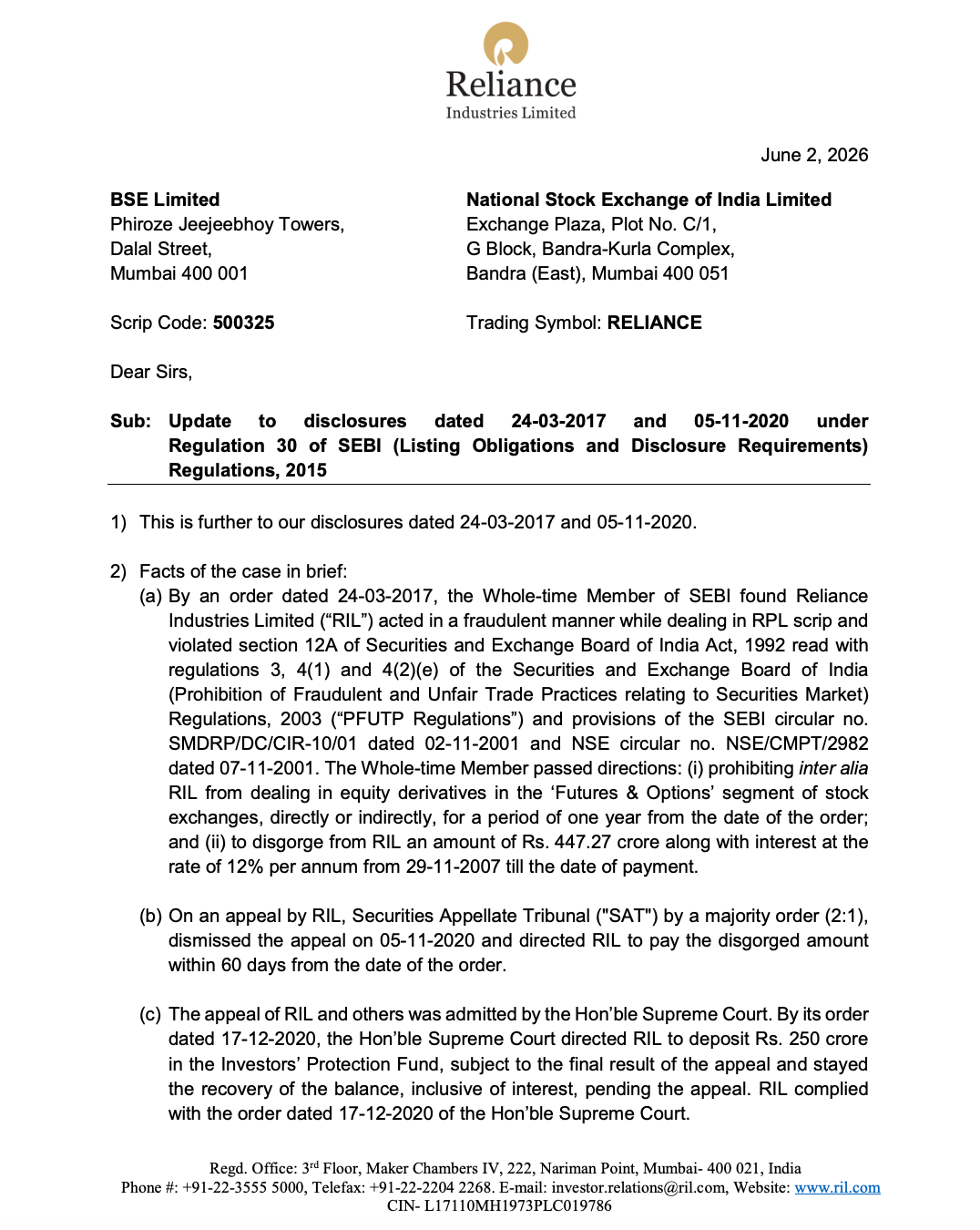
Reliance Industries Limited (RIL) informed exchanges that the Supreme Court, through its judgment dated May 29, 2026, has set aside findings of fraud under SEBI’s PFUTP Regulations in the long-running Reliance Petroleum Limited (RPL) derivatives matter. The Court, however, upheld that RIL violated disclosure requirements relating to position limits and remains liable for penalties under applicable 2001 SEBI and NSE circulars.
PRICE-SENSITIVE TRIGGER
Event: Supreme Court Judgment in RPL Derivatives Case
Type: Litigation Outcome / Judicial Order
Impact: Positive
Immediate Effect: The Supreme Court has removed fraud-related findings and associated legal interpretations against RIL while maintaining liability only for disclosure-related violations regarding position limits.
Key Metrics:
- Original Disgorgement Amount Ordered by SEBI: ₹447.27 crore
- Amount Deposited Pursuant to Supreme Court Interim Order: ₹250 crore
- AO Penalty (2021): ₹25 crore
- Supreme Court Judgment Date: 29-May-2026
Highlight:
- The Supreme Court held that fraud under PFUTP Regulations is not established against Reliance Industries in the RPL matter.
What Happened ?
Reliance Industries updated investors regarding the outcome of two civil appeals before the Supreme Court arising from proceedings initiated by SEBI in connection with trading activity in Reliance Petroleum Limited (RPL) derivatives.
The Supreme Court ruled that allegations of fraud under the SEBI (Prohibition of Fraudulent and Unfair Trade Practices) Regulations were not made out against RIL. The Court set aside findings of fraud recorded in earlier orders and held that the Securities Appellate Tribunal (SAT) had erred in its interpretation of fraud provisions under the PFUTP Regulations.
At the same time, the Court held that RIL violated disclosure requirements relating to position limits under applicable 2001 SEBI and NSE circulars and concurred with penalties relating to those disclosure violations.
Key Details
Supreme Court Ruling – RPL Derivatives Matter:
- Matter originated from SEBI proceedings relating to trading in Reliance Petroleum Limited (RPL) derivatives.
- SEBI Whole-Time Member order dated 24 March 2017 had held RIL acted fraudulently and imposed disgorgement directions.
- SAT, through a majority order dated 5 November 2020, dismissed RIL’s appeal.
- Supreme Court admitted RIL’s appeal and directed a deposit of ₹250 crore pending final adjudication.
- Adjudicating Officer had separately imposed a ₹25 crore penalty in January 2021.
- Supreme Court judgment dated 29 May 2026 held that fraud under PFUTP Regulations was not established against RIL.
- Court observed that SAT committed a significant error in relation to findings under Regulations 3 and 4 of PFUTP Regulations.
- Fraud-related findings and corresponding portions of SAT’s order were set aside.
- Court held that RIL violated disclosure requirements relating to position limits.
- Liability for disclosure-related penalties under applicable SEBI and NSE circulars remains intact.
Note:
- The judgment substantially narrows the scope of regulatory findings against Reliance Industries by removing fraud allegations while retaining only disclosure-compliance violations.
Risk Analysis
Summary:
- The removal of fraud findings significantly reduces legal and reputational overhang. However, the company remains subject to consequences associated with disclosure-related violations and any residual regulatory obligations arising from the matter.
Key Risks:
- Disclosure violation findings remain valid.
- Penalties linked to position-limit disclosures continue to apply.
- Further procedural or settlement actions may still be required.
- Regulatory scrutiny of compliance practices may continue.
- Long-term governance monitoring remains relevant for investors.
Worst Case Scenario:
- Any subsequent regulatory interpretation or compliance action related to disclosure violations could create additional financial or reputational implications, though fraud-related allegations have been dismissed.
Risk Level: Low
Company Commentary
- The Supreme Court held that fraud under PFUTP Regulations is not made out against Reliance Industries.
- The Court set aside SAT findings concerning fraud allegations.
- The Court found that RIL violated disclosure requirements relating to position limits.
- The judgment concurred with SAT observations regarding penalties linked to disclosure violations.
- The disclosure was made as an update to earlier regulatory filings dated March 24, 2017 and November 5, 2020.
Official Exchange Filing: Reliance Industries Limited