Capacity Expansion
Jain Irrigation Commissions Industrial-Scale High-Tech Biochar Facility Among the World’s Largest Single-Unit Biochar Reactors
NSE
JISLJALEQS
BSE
500219
Jain Irrigation Systems Limited (JISL) has commissioned an industrial-scale high-tech biochar facility at Jalgaon, Maharashtra, with annual processing capacity of approximately 20,000 tonnes of agricultural and fruit-processing residue. The facility is among the world’s largest single-unit biochar reactors and is designed to support climate-smart agriculture, carbon removal and farm-to-soil circular economy initiatives.
PRICE-SENSITIVE TRIGGER
Event: Commissioning of industrial-scale high-tech biochar facility.
Type: Capacity Expansion / Sustainability Initiative
Impact: Positive
Immediate Effect: The facility expands JISL’s presence in climate-smart agriculture and carbon removal solutions while creating a new sustainability-focused business platform linked to biochar production and carbon credits.
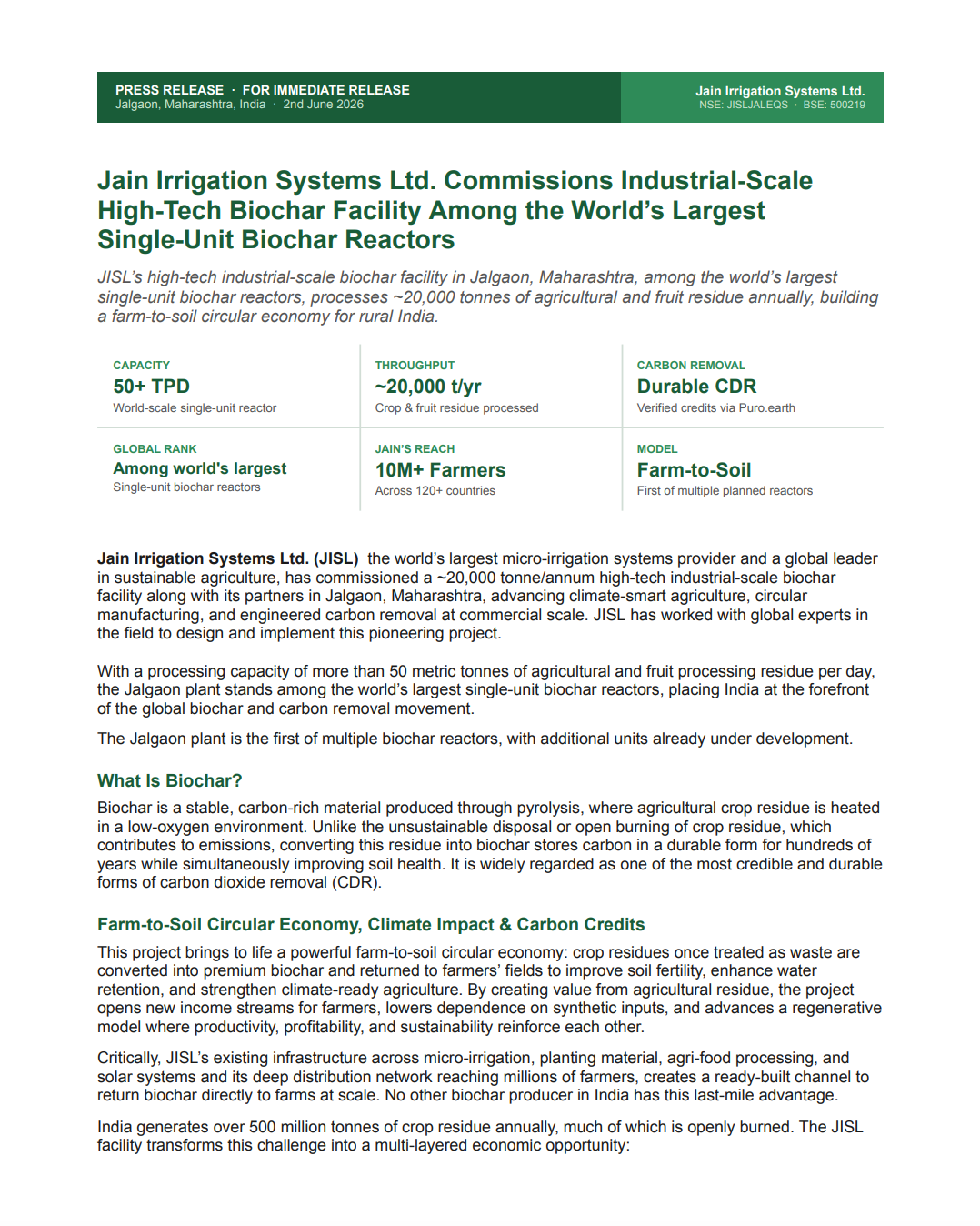
Key Metrics:
- Biochar Processing Capacity: 50+ tonnes per day (TPD)
- Annual Throughput: ~20,000 tonnes per year
- Farmer Reach: 10+ million farmers
- Global Presence: 120+ countries
- Carbon Removal Product: Durable Carbon Dioxide Removal (CDR) credits
- Facility Scale: Among the world’s largest single-unit biochar reactors
Highlight:
- The Jalgaon facility processes approximately 20,000 tonnes of agricultural and fruit residue annually, positioning JISL at the forefront of commercial-scale biochar and carbon removal infrastructure.
What Happened ?
Jain Irrigation Systems Limited announced the commissioning of a high-tech industrial-scale biochar facility in Jalgaon, Maharashtra.
The facility converts agricultural and fruit-processing residue into biochar through advanced pyrolysis technology. The project is designed to create a farm-to-soil circular economy by transforming agricultural waste into a carbon-rich soil amendment while generating durable carbon removal credits.
JISL stated that the Jalgaon plant is the first of multiple planned biochar reactors and is expected to strengthen sustainable agriculture, carbon sequestration and rural economic development.
Key Details
Industrial Biochar Facility:
- Facility commissioned at Jalgaon, Maharashtra.
- Processes approximately 20,000 tonnes of agricultural and fruit-processing residue annually.
- Daily processing capacity exceeds 50 metric tonnes.
- Biochar produced can improve soil fertility, water retention and long-term farm productivity.
- Generates durable, measurable and verifiable carbon dioxide removal (CDR) credits.
- Developed in partnership with global carbon removal ecosystem participants.
- First reactor in a planned network of future biochar facilities.
- Supports circular utilization of agricultural residues that would otherwise be burned or discarded.
Climate & Agricultural Benefits:
- Promotes carbon sequestration for hundreds of years through biochar application.
- Helps reduce stubble burning and associated emissions.
- Improves soil organic carbon levels.
- Enhances water-use efficiency and agricultural sustainability.
- Creates additional income opportunities for farmers through participation in carbon markets.
- Supports India’s climate action and decarbonization goals.
Note:
- JISL’s extensive distribution network and relationships with millions of farmers provide a significant advantage in scaling biochar adoption compared with standalone carbon removal projects.
Risk Analysis
Summary:
- The project introduces a new sustainability-focused growth avenue, but commercial success will depend on carbon credit monetization, farmer adoption rates and long-term demand for biochar-based carbon removal solutions.
Key Risks:
- Carbon credit markets remain subject to pricing and regulatory uncertainty.
- Revenue visibility depends on certification and acceptance of carbon removal credits.
- Large-scale farmer adoption is necessary to maximize project benefits.
- Biochar commercialization remains an emerging industry globally.
- Expansion of future facilities will require sustained operational and economic viability.
Worst Case Scenario:
- If carbon credit demand weakens or certification economics become less attractive, the project may generate lower-than-expected returns despite its environmental benefits.
Risk Level: Medium
Company Commentary
- Management described the project as a significant milestone in creating shared value through sustainable agriculture.
- JISL stated that the initiative reimagines agricultural residue as a valuable resource within a circular economy framework.
- The company emphasized benefits for farmers, soil health and long-term agricultural productivity.
- Industry participants highlighted the project’s relevance for durable carbon removal, water retention and reduced fertilizer dependence.
- Management indicated that additional biochar reactors are already under development.
Official Exchange Filing: Jain Irrigation Systems Limited