Regulatory Disclosure
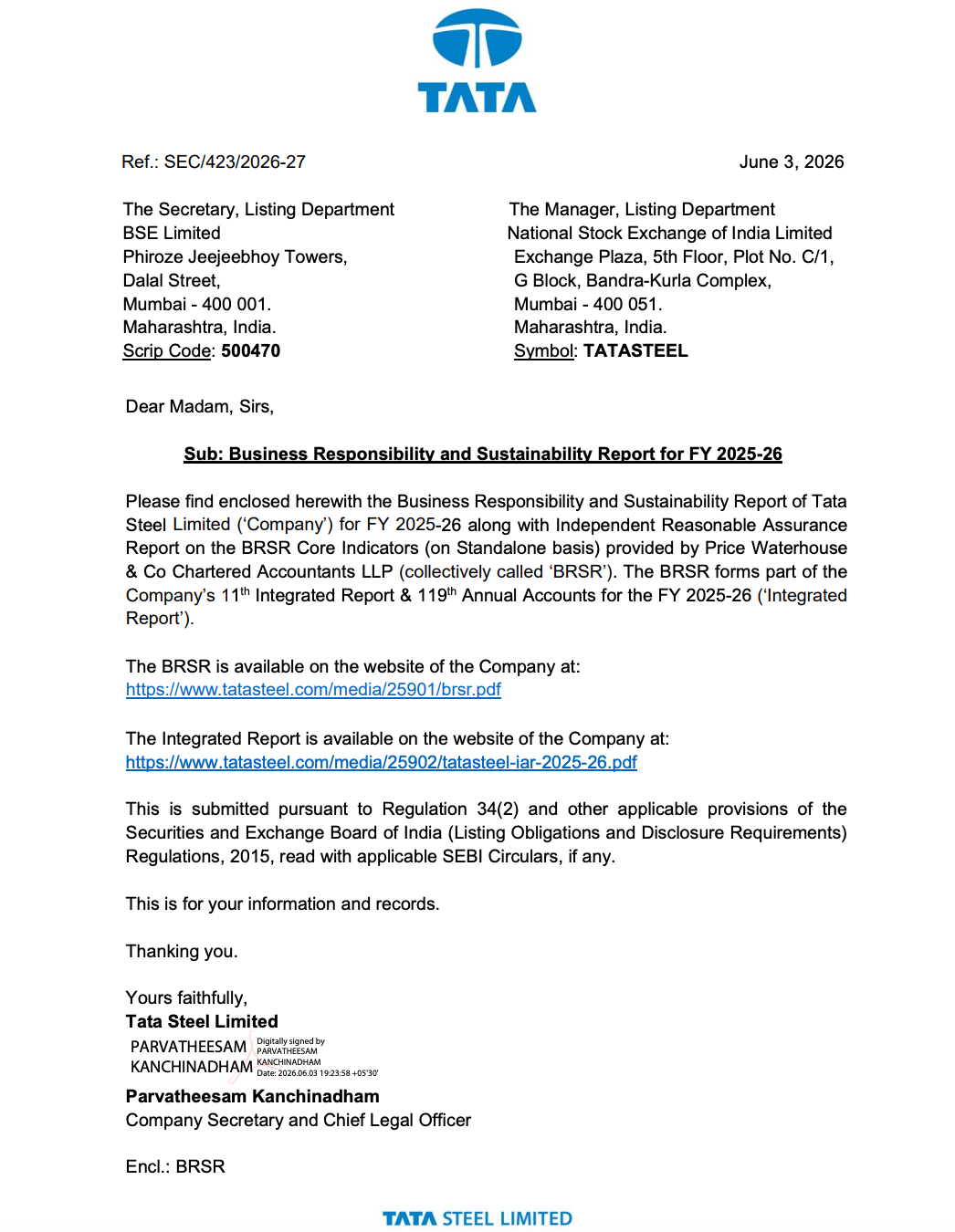
Tata Steel Files FY2025-26 Business Responsibility & Sustainability Report Along With Independent Assurance Report
NSE
tatasteel
BSE
500470
Tata Steel has submitted its FY2025-26 Business Responsibility & Sustainability Report (BRSR) along with an Independent Reasonable Assurance Report on BRSR Core Indicators. The report forms part of the company’s 11th Integrated Report and 119th Annual Accounts and outlines Tata Steel’s ESG performance, governance framework, sustainability priorities, climate commitments, stakeholder engagement practices, and responsible business conduct initiatives.
PRICE-SENSITIVE TRIGGER
Event: Submission of FY2025-26 Business Responsibility & Sustainability Report (BRSR)
Type: Regulatory Disclosure
Impact: Neutral
Immediate Effect: Provides investors with updated ESG, sustainability, governance, and responsible business conduct disclosures.
What Happened ?
Tata Steel submitted its Business Responsibility & Sustainability Report for FY2025-26 to the stock exchanges pursuant to Regulation 34(2) of SEBI Listing Regulations.
The report forms part of the company’s Integrated Report and Annual Accounts and covers disclosures relating to:
- Environmental performance
- Climate strategy
- Employee well-being
- Human rights
- Governance practices
- Supply chain sustainability
- Community development
- Stakeholder engagement
- Responsible business conduct
The company also included an Independent Reasonable Assurance Report issued by Price Waterhouse & Co Chartered Accountants LLP covering BRSR Core Indicators on a standalone basis.
Key Details
Sustainability & Climate Strategy:
- Tata Steel reaffirmed its commitment to achieve Net Zero emissions by 2045.
- Decarbonisation remains a strategic priority across operations.
- The company continues investments in low-emission steelmaking technologies.
- Circular economy initiatives are being expanded through increased steel scrap utilization.
- Energy efficiency and renewable energy adoption remain core operational priorities.
Note:
- Climate transition continues to be one of the most material strategic themes identified by the company.
Responsible Supply Chain:
- Responsible Supply Chain Policy strengthened across the supplier ecosystem.
- 1,359 critical suppliers were assessed across ESG parameters during FY2025-26.
- Supplier compliance levels improved year-on-year.
- The company expanded initiatives aimed at reducing Scope 3 emissions.
- Green logistics and cleaner transportation solutions remain focus areas.
Note:
- Supply chain sustainability has been identified as a material business risk and long-term opportunity.
Employee & Workforce Development:
- Employee well-being, safety and workforce development remained key priorities.
- Company-wide AI and digital capability development initiatives were undertaken.
- Leadership development and future-ready workforce programmes were expanded.
- Continued focus on diversity, inclusion and employee engagement.
Note:
- People development remains a key component of Tata Steel’s ESG framework.
Community & Social Impact:
- Tata Steel Foundation impacted over 6.9 million lives during FY2025-26.
- CSR initiatives focused on:
- Education
- Healthcare
- Livelihood generation
- Community infrastructure
- Special emphasis continued on women, tribal communities and socially vulnerable groups.
Note:
- Community engagement remains important for maintaining long-term social licence to operate.
Governance & Oversight:
- Board-level committees continue to oversee sustainability and ESG matters.
- ResponsibleSteel certification maintained across major Indian steelmaking locations.
- Independent assurance undertaken on BRSR Core indicators.
- Multiple international standards and certifications continue to support governance and operational excellence.
Note:
- The Board remains the highest authority overseeing implementation of business responsibility policies.
Risk Analysis
Summary:
- The report highlights climate transition, environmental compliance, operational safety, supply chain sustainability, and regulatory obligations as key sustainability-related risks.
Key Risks:
- Greenhouse gas emissions and climate transition risk.
- Water consumption and effluent management risk.
- Air quality and environmental compliance risk.
- Occupational health and safety risk.
- Biodiversity and ecological impact risk.
- Supply chain sustainability and Scope 3 emissions risk.
- Regulatory compliance and ESG reporting obligations.
Worst Case Scenario:
- Failure to manage environmental, climate, safety or regulatory risks could lead to increased compliance costs, operational restrictions, reputational damage, or regulatory actions.
Risk Level: Medium
Company Commentary
- Sustainability remains embedded within Tata Steel’s long-term business strategy.
- Decarbonisation efforts are progressing from commitment to measurable implementation.
- Digitalisation, automation and AI are being leveraged to improve sustainability performance.
- Social investments continue to focus on inclusive growth and community development.
- Governance, transparency and ethical conduct remain foundational pillars of the company’s ESG framework.
Official Exchange Filing: Tata Steel Limited