Investment Partnership
APSEZ Expands Partnership with Kaleris to Accelerate AI-Led Transformation Across Port and Logistics Network
NSE
ADANIPORTS
BSE
532921
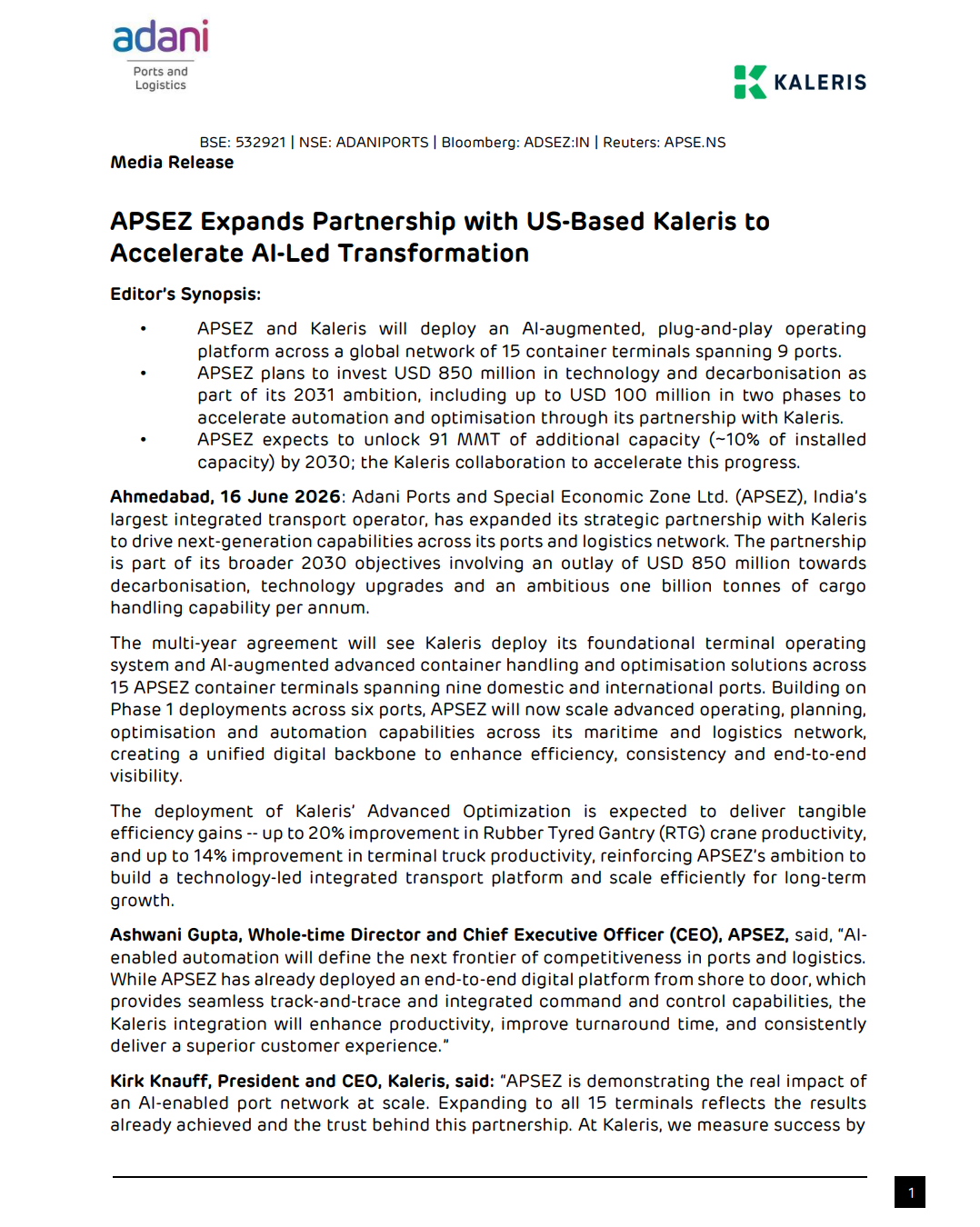
Adani Ports and Special Economic Zone (APSEZ) has expanded its strategic partnership with US-based Kaleris to deploy AI-enabled terminal operating and optimization solutions across its network of 15 container terminals spanning nine ports. The initiative supports APSEZ’s broader technology and decarbonization strategy, with the company targeting one billion tonnes of cargo handling capacity annually by 2030.
PRICE-SENSITIVE TRIGGER
Event: Expansion of strategic technology partnership with Kaleris
Type: Investment Partnership / Expansion
Impact: Positive
Immediate Effect: APSEZ will scale AI-powered terminal operating systems, automation, planning and optimization solutions across its ports and logistics network to improve efficiency, productivity and cargo visibility.
Key Metrics:
- Planned Technology & Decarbonization Investment (2031 ambition): USD 850 million
- Additional Investment through Kaleris Partnership (Two Phases): Up to USD 100 million
- Expected Additional Capacity Unlock by 2030: 91 MMT
- Installed Capacity Impact: Approximately 10%
- APSEZ Current Cargo Handling Capacity: 653 million tonnes per annum
- APSEZ Cargo Handling Target by 2030: 1 billion tonnes annually
- Number of Container Terminals Covered: 15
- Ports Covered: 9
- Revenue: Not disclosed
- EBITDA: Not disclosed
- PAT: Not disclosed
- Margins: Not disclosed
- QoQ Movement: Not disclosed
- YoY Movement: Not disclosed
- Segment Performance: Not disclosed
Highlight:
- APSEZ plans USD 850 million of technology and decarbonization investments while targeting one billion tonnes of annual cargo handling capacity by 2030.
What Happened ?
APSEZ announced an expansion of its partnership with Kaleris, a US-based supply chain and terminal operations software provider. Under the multi-year agreement, Kaleris will deploy its terminal operating system (N4), AI-enabled optimization tools and advanced container handling solutions across APSEZ’s network of 15 container terminals spanning nine domestic and international ports.
The initiative is intended to create a unified digital operating platform across APSEZ’s maritime and logistics ecosystem while supporting the company’s long-term automation, efficiency and capacity expansion objectives.
Key Details
Technology Deployment and Operational Benefits:
- Kaleris will expand deployment of its N4 Terminal Operating System (TOS) across APSEZ’s terminal network.
- The rollout covers 15 container terminals across nine ports.
- APSEZ will integrate AI-enabled planning, optimization and automation capabilities into terminal operations.
- The deployment follows successful Phase-1 implementation across six ports.
- Kaleris’ Advanced Optimization platform is expected to improve Rubber Tyred Gantry (RTG) crane productivity by up to 20%.
- Terminal truck productivity is expected to improve by up to 14%.
- The platform will enhance yard utilization, vessel turnaround times, planning accuracy and cargo visibility.
- APSEZ aims to establish a unified digital backbone across ports, rail, roads, trucking, warehouses and cargo gateways.
- The company expects the partnership to contribute toward unlocking an additional 91 MMT of capacity by 2030.
Note:
- The initiative forms part of APSEZ’s broader strategy of combining AI, IoT, automation and digital infrastructure investments to support scalable growth and operational efficiency across its integrated logistics network.
Risk Analysis
Summary:
- The partnership is focused on operational transformation rather than immediate financial gains. Benefits will depend on successful implementation, technology adoption and achievement of projected productivity improvements across the network.
Key Risks:
- Expected productivity gains remain subject to successful deployment and operational execution.
- Large-scale technology integration across multiple terminals increases implementation complexity.
- Capacity unlocking targets depend on broader cargo growth and infrastructure expansion plans.
- Realization of returns from planned technology investments may take multiple years.
- Operational disruptions during migration and deployment phases cannot be ruled out.
Worst Case Scenario:
- If deployment delays, integration challenges or lower-than-expected adoption occur, APSEZ may not fully realize the projected productivity improvements and capacity expansion benefits anticipated from the partnership.
Risk Level: Medium
Company Commentary
- APSEZ stated that AI-enabled automation will define the next phase of competitiveness in ports and logistics.
- The company believes the Kaleris integration will improve productivity, reduce turnaround times and enhance customer experience.
- APSEZ plans to leverage AI, IoT, computer vision and advanced optimization tools to improve operational decision-making.
- The company reiterated its ambition to handle one billion tonnes of cargo annually by 2030.
- Kaleris highlighted that expanding deployment across all 15 terminals reflects the operational results achieved through the existing partnership.
Official Exchange Filing: Adani Ports and Special Economic Zone Limited