Credit Rating Update
SBI Secures Fresh AA+/Stable Rating for ₹5,000 Crore Basel III Tier-I Bonds; CRISIL and CARE Reaffirm Key Debt Ratings
NSE
sbin
BSE
500112
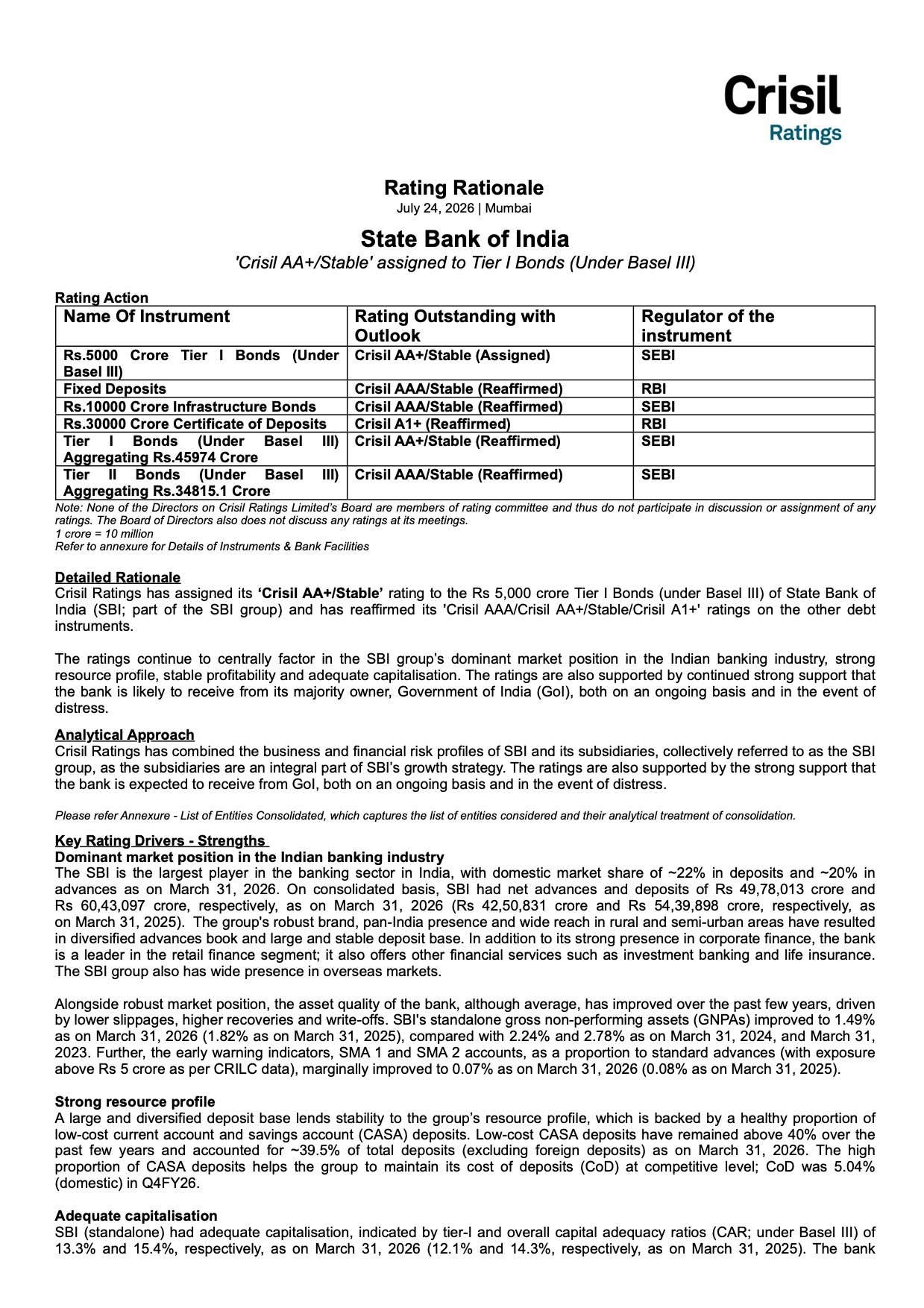
- State Bank of India (SBI) announced that CRISIL Ratings and CARE Ratings have assigned AA+/Stable ratings to its proposed ₹5,000 crore Basel III Additional Tier-I Bonds, while reaffirming existing ratings across infrastructure bonds, Tier-I bonds, Tier-II bonds, fixed deposits and certificates of deposit.
- Both rating agencies cited SBI’s dominant market position, improving asset quality, strong deposit franchise, adequate capitalisation, healthy liquidity and continued support from the Government of India as the key factors underpinning the ratings.
PRICE-SENSITIVE TRIGGER
Event: State Bank of India informed the stock exchanges that CRISIL Ratings Limited and CARE Ratings Limited had issued updated rating rationales for the bank’s debt instruments.
Type: Credit Rating Update
Impact: Positive
Immediate Effect: The fresh assignment of AA+/Stable to the proposed ₹5,000 crore Basel III Tier-I Bonds, along with reaffirmation of existing ratings across multiple debt instruments, reflects continued confidence in SBI’s credit profile, capital strength and financial stability. The rating action is expected to support the bank’s future capital-raising plans at competitive borrowing costs.
Metrics:
Key Financial & Business Metrics:
- Consolidated Deposits: ₹60.43 lakh crore (31 March 2026)
- Consolidated Net Advances: ₹49.78 lakh crore
- Domestic Deposit Market Share: ~22%
- Domestic Advances Market Share: ~20%
- Standalone Gross NPA: 1.49% (vs. 1.82% a year earlier)
- Tier-I Capital Ratio: 13.3%
- Overall Capital Adequacy Ratio: 15.4%
- Standalone Profit After Tax (FY26): ₹80,032 crore
- Consolidated Profit After Tax (FY26): ₹83,299 crore
- Liquidity Coverage Ratio (Consolidated): 124.32%
- Government of India Shareholding: 55.03% (as on 31 March 2026)
Rating Actions:
- CRISIL Ratings
- ₹5,000 crore Basel III Tier-I Bonds: CRISIL AA+/Stable (Assigned)
- Existing Basel III Tier-I Bonds: CRISIL AA+/Stable (Reaffirmed)
- Basel III Tier-II Bonds: CRISIL AAA/Stable (Reaffirmed)
- Infrastructure Bonds: CRISIL AAA/Stable (Reaffirmed)
- Fixed Deposits: CRISIL AAA/Stable (Reaffirmed)
- Certificates of Deposit: CRISIL A1+ (Reaffirmed)
- CARE Ratings
- ₹5,000 crore Basel III Tier-I Bonds: CARE AA+/Stable (Assigned)
- Existing Basel III Tier-I Bonds: CARE AA+/Stable (Reaffirmed)
- Infrastructure Bonds: CARE AAA/Stable (Reaffirmed)
- Basel III Tier-II Bonds: CARE AAA/Stable (Reaffirmed)
Highlight:
- The rating actions reaffirm SBI’s position as India’s strongest public sector bank from a credit perspective.
- Both agencies highlighted improving asset quality, strong earnings, adequate capital buffers, healthy liquidity and continued sovereign support as the principal strengths supporting the bank’s ratings.
What Happened ?
State Bank of India informed investors that CRISIL and CARE Ratings had completed their latest review of the bank’s debt instruments. Both agencies reaffirmed the existing high investment-grade ratings across SBI’s borrowing programmes while assigning AA+/Stable to the bank’s proposed ₹5,000 crore Basel III Additional Tier-I bond issuance.
The rating rationales indicate that SBI continues to benefit from its dominant domestic franchise, diversified loan book, stable deposit base, improving asset quality and adequate capitalisation. The agencies also recognised the importance of continued ownership and expected support from the Government of India, given SBI’s systemic importance within India’s financial system.
The announcement does not involve any change in the bank’s operating performance but strengthens investor confidence regarding SBI’s creditworthiness and funding profile.
Rating Rationale
Strong Market Leadership:
Both CRISIL and CARE highlighted SBI’s leadership within the Indian banking sector.
- Largest bank in India by deposits and advances.
- Approximately 22% market share in deposits.
- Approximately 20% market share in advances.
- Extensive domestic branch network supported by a significant international presence.
- Diversified business across corporate banking, retail banking, investment banking, insurance, cards and asset management.
Improving Asset Quality
Asset quality continued improving during FY26.
- Gross NPA reduced to 1.49%.
- Lower slippages and higher recoveries strengthened credit quality.
- Credit costs continued declining compared with previous years.
- Early warning accounts remained at very low levels.
Strong Deposit Franchise
The rating agencies emphasised SBI’s funding strength.
- Large and diversified retail deposit base.
- CASA ratio remained around 39.5%.
- Competitive cost of deposits.
- Strong liquidity profile supported by retail funding and access to multiple funding sources.
Capital Position
SBI continues maintaining comfortable regulatory capital buffers.
- Tier-I Capital Ratio improved to 13.3%.
- Overall Capital Adequacy Ratio improved to 15.4%.
- The ₹25,000 crore Qualified Institutional Placement (QIP) completed in July 2025 further strengthened capital.
- Internal capital generation remains robust and supports future business growth.
Profitability
The agencies noted continued improvement in earnings quality.
- Standalone FY26 profit reached ₹80,032 crore.
- Consolidated FY26 profit increased to ₹83,299 crore.
- Lower provisioning requirements following improvement in asset quality supported profitability.
- Return on Assets remained above 1%, reflecting stable earnings performance.
Government Support
A key pillar supporting the ratings remains SBI’s relationship with the Government of India.
- Government holds 55.03% equity.
- Rating agencies expect continued capital support whenever required.
- SBI’s systemic importance makes sovereign support highly probable during periods of financial stress.
- Government ownership also provides flexibility for future capital raising if required.
ESG & Sustainability
CRISIL also highlighted SBI’s sustainability initiatives.
- Target to achieve carbon neutrality in operations by 2030.
- Net-zero emissions target across Scope 1, 2 and 3 by 2055.
- Increase green financing as a proportion of advances by 2030.
- Continued reduction in operational emissions and higher renewable energy adoption.
- Strong governance framework supported by independent directors and transparent disclosures.
Note
- The latest rating actions reinforce SBI’s position as India’s strongest public sector banking franchise from a credit standpoint.
- Continued improvement in asset quality, stable profitability, strong capital adequacy and sovereign support provide the bank with significant flexibility to fund future business growth while maintaining high investor confidence in its debt instruments.
Risk Analysis
Summary:
- Despite maintaining one of the strongest credit profiles in the Indian banking sector, SBI remains exposed to macroeconomic conditions, credit cycles and regulatory developments that influence the banking industry.
Key Risks:
- A sharp deterioration in asset quality could increase credit costs.
- Sustained pressure on net interest margins may affect profitability.
- Large-scale economic slowdown could weaken loan growth and recoveries.
- Future Basel capital requirements may require additional capital raising.
- Rising competition from private banks and digital financial institutions may affect market share in selected segments.
- Rating agencies continue to monitor profitability, credit costs and capital adequacy.
Worst Case:
- A significant increase in stressed assets combined with weaker profitability and lower capital buffers could place pressure on SBI’s credit profile, although ongoing government ownership and systemic importance are expected to provide substantial support.
Risk Level: Low
Company Commentary
- Fresh AA+/Stable rating assigned to the proposed ₹5,000 crore Basel III Tier-I Bonds.
- Existing ratings across major debt instruments reaffirmed by both CRISIL and CARE.
- Rating agencies highlighted SBI’s dominant banking franchise, improving asset quality and strong capital position.
- Continued sovereign ownership and support remain central to the bank’s high credit standing.
- Strong liquidity, diversified funding base and improving profitability continue to reinforce SBI’s long-term financial strength.
Official Exchange Filing: State Bank of India Limited