Renewable Energy Infrastructure
Adani Green commissions world’s largest single-location battery energy storage system of 3.37 GWh at Khavda
NSE
adanigreen
BSE
541450
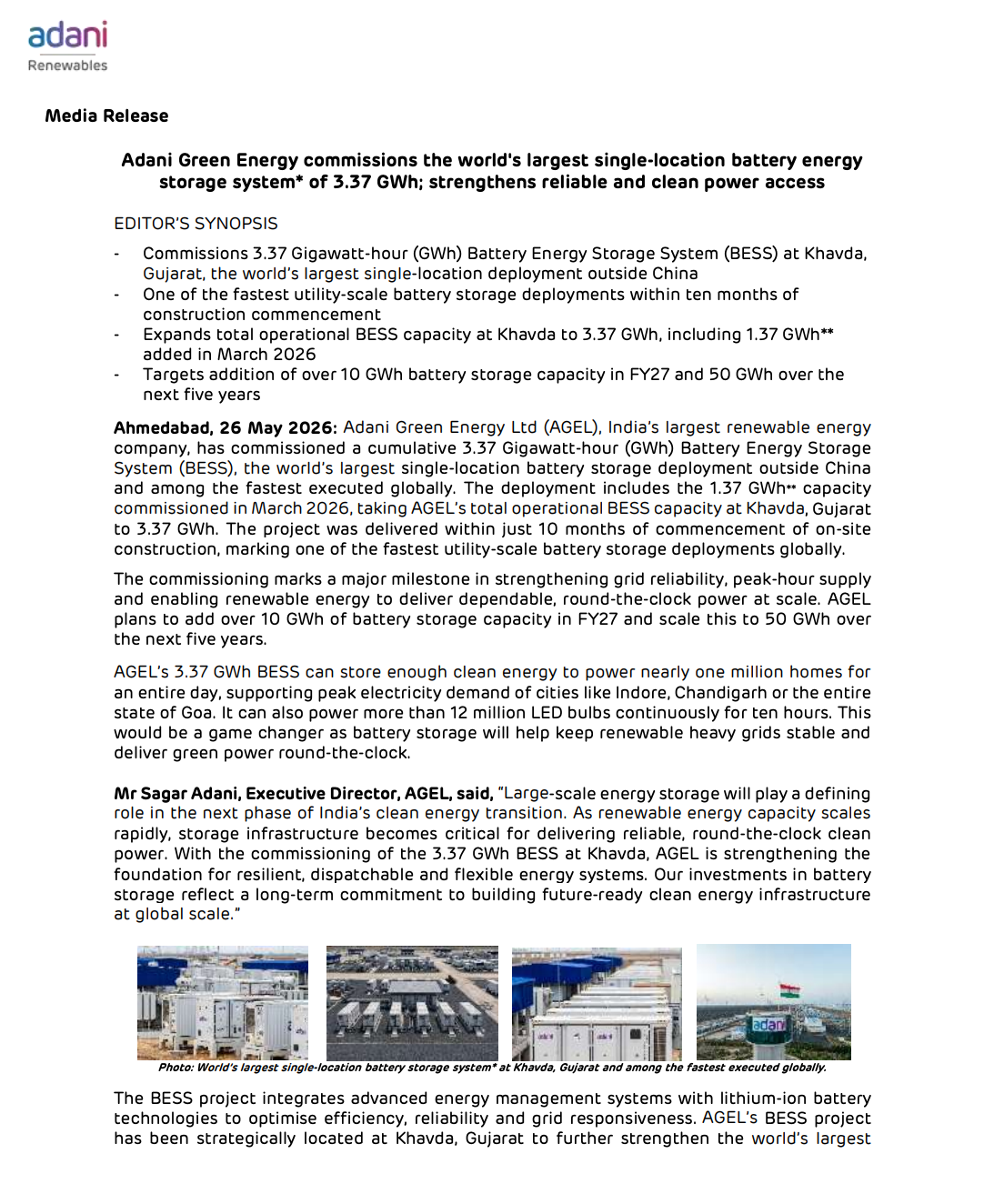
Adani Green Energy Limited (AGEL) has commissioned a cumulative 3.37 GWh Battery Energy Storage System (BESS) at Khavda, Gujarat, making it the world’s largest single-location battery storage deployment outside China. The project strengthens AGEL’s clean energy infrastructure capabilities and supports reliable round-the-clock renewable power delivery.
PRICE-SENSITIVE TRIGGER
Event: Commissioning of large-scale Battery Energy Storage System (BESS) infrastructure at Khavda, Gujarat.
Type: Renewable Energy Investment
Impact: Positive
Immediate Effect: The commissioning significantly expands AGEL’s utility-scale energy storage capabilities, improves renewable energy dispatch reliability, and strengthens the company’s leadership position in large-scale clean energy infrastructure.
Key Metrics:
- Total Operational BESS Capacity at Khavda: 3.37 GWh
- Additional Capacity Added in March 2026: 1.37 GWh
- Target Additional Battery Storage Capacity in FY27: Over 10 GWh
- Long-Term BESS Expansion Target: 50 GWh over next five years
- Khavda Renewable Energy Development Target: 30 GW by 2029
- Operational Renewable Capacity at Khavda: 9.9 GW
- Homes Potentially Powered by BESS: Nearly 1 million homes for one day
- Equivalent LED Lighting Support: More than 12 million LED bulbs for 10 hours
Highlight:
- Label: Global Battery Storage Milestone
- Value: AGEL commissioned the world’s largest single-location battery energy storage deployment outside China with cumulative operational capacity of 3.37 GWh.
What Happened ?
Adani Green Energy Limited (AGEL) announced the commissioning of a cumulative 3.37 GWh Battery Energy Storage System (BESS) at its Khavda renewable energy complex in Gujarat.
The deployment was completed within approximately 10 months of construction commencement, making it one of the fastest executed utility-scale battery storage projects globally.
The newly commissioned storage infrastructure enhances AGEL’s ability to deliver dependable, dispatchable, and round-the-clock renewable energy while improving grid reliability and peak-hour supply management.
The project forms part of AGEL’s broader renewable energy expansion strategy at Khavda, where the company is developing a 30 GW renewable energy park.
Key Details
Battery Storage Expansion &
Renewable Infrastructure Development:
- The BESS deployment at Khavda now totals 3.37 GWh operational capacity.
- The project includes the 1.37 GWh capacity commissioned earlier in March 2026.
- The storage infrastructure integrates advanced energy management systems and lithium-ion battery technologies.
- The project is designed to improve:
- Grid stability
- Peak demand management
- Renewable intermittency balancing
- Round-the-clock clean power delivery
- AGEL plans to add more than 10 GWh of battery storage capacity during FY27.
- The company targets scaling battery storage infrastructure to 50 GWh over the next five years.
- The battery storage project supports AGEL’s broader Khavda renewable ecosystem where 9.9 GW is already operational.
- The Khavda renewable complex is planned to scale to 30 GW by 2029.
- The BESS infrastructure strengthens dispatchable renewable energy capabilities as renewable penetration increases across grids.
- Management highlighted battery storage as critical infrastructure for future clean energy transition and renewable-heavy grid stabilization.
Note:
- The commissioning reinforces AGEL’s positioning in utility-scale renewable infrastructure and energy storage integration, an increasingly strategic segment within global clean energy systems.
Risk Analysis
Summary:
- Large-scale battery storage infrastructure remains exposed to technology evolution risks, execution complexity, battery supply chain dependency, and evolving regulatory economics for energy storage deployment.
Key Risks:
- Battery storage economics remain sensitive to lithium-ion supply chain pricing and raw material volatility.
- Utility-scale storage deployment requires continuous operational efficiency and thermal management reliability.
- Rapid expansion targets may increase capital expenditure and execution risks.
- Renewable energy dispatch frameworks and grid storage regulations continue evolving in India.
- Long-term return realization depends on grid utilization rates and renewable energy demand growth.
- Technology shifts in battery chemistry could impact future competitiveness and replacement economics.
Worst Case Scenario:
- Delays in scaling future storage projects or lower-than-expected utilization economics could pressure returns on large battery infrastructure investments.
Risk Level: Medium
Company Commentary
- Executive Director Sagar Adani stated that large-scale energy storage will play a defining role in India’s next phase of clean energy transition.
- Management highlighted that the Khavda BESS strengthens AGEL’s ability to deliver reliable, dispatchable and flexible renewable power infrastructure.
- The company emphasized that battery storage investments reflect a long-term commitment toward future-ready clean energy systems.
- AGEL stated that BESS deployment demonstrates how renewable energy can evolve from intermittent generation into dependable infrastructure at scale.
- Management reiterated plans to significantly scale battery storage capacity in FY27 and over the next five years.
Official Exchange Filing: Adani Green Energy Limited