Defence Order
Apollo Micro Systems Awarded Indian Air Force Make-II Prototype Order for Indigenous Smart Bomb Programme
NSE
apollo
BSE
540879
- Apollo Micro Systems Limited has been awarded a Make-II Prototype Sanction Order (PSO) by the Indian Air Force (IAF) under the Ministry of Defence’s Make-II framework for the development of an indigenous 500 kg Smart Bomb.
- The project marks the company’s entry as a Prime OEM into India’s precision-guided munition (PGM) segment, one of the country’s most strategic and import-dependent defence sectors.
PRICE-SENSITIVE TRIGGER
Event: Award of Make-II Prototype Sanction Order
Type: Defence Order
Impact: Positive
Immediate Effect: The sanction order positions Apollo Micro Systems as a Prime OEM in the precision-guided munition segment and expands its presence in high-value indigenous defence technologies. Under the Make-II policy, the government will procure the system after successful prototype development and demonstration.
What Happened ?
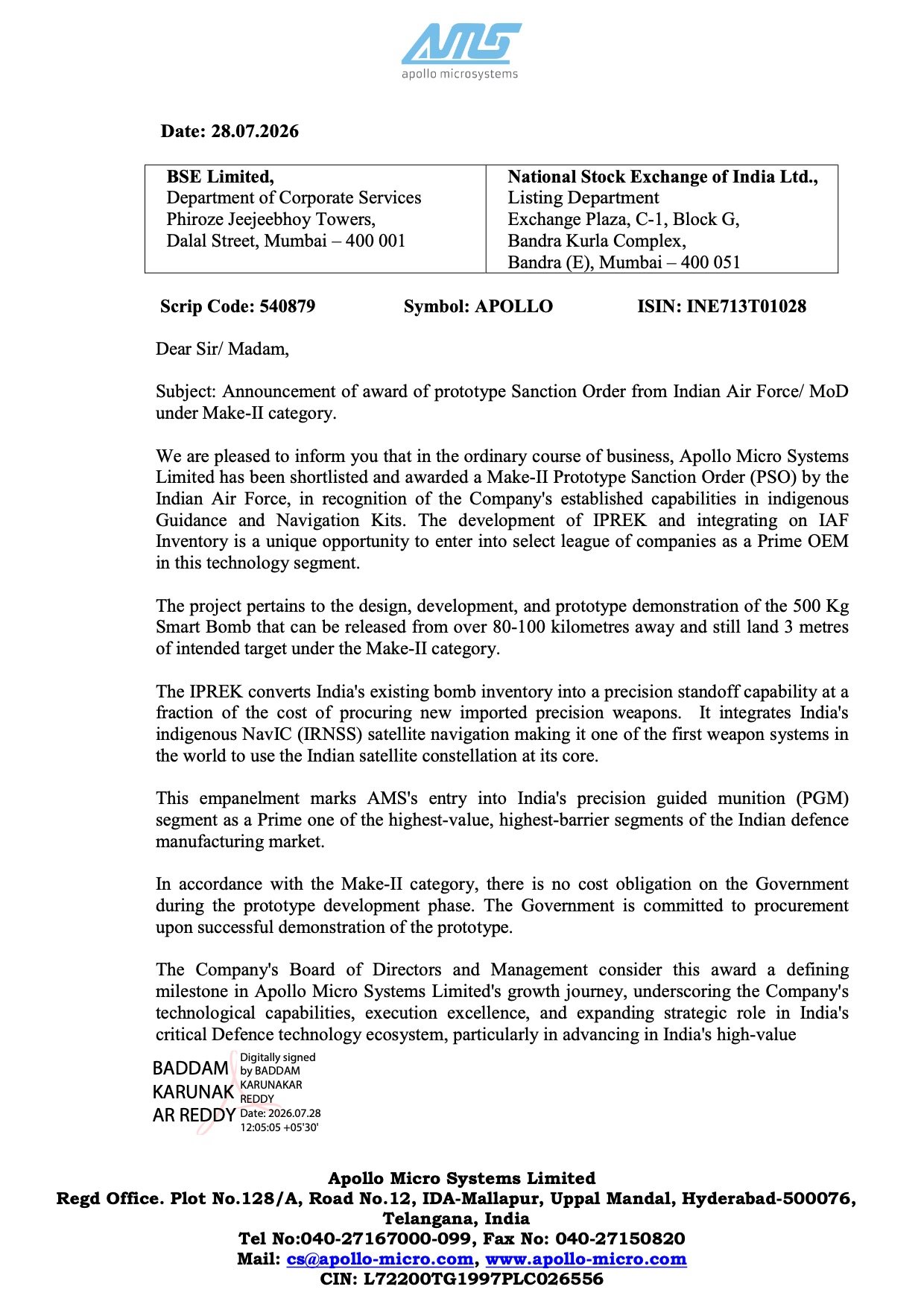
Apollo Micro Systems announced that it has been shortlisted and awarded a Prototype Sanction Order (PSO) by the Indian Air Force for designing, developing and demonstrating an indigenous 500 kg Smart Bomb under the Ministry of Defence’s Make-II initiative.
The proposed weapon system will enable aircraft to release the bomb from a distance of 80–100 kilometres while maintaining an accuracy of approximately 3 metres from the intended target.
The company stated that the programme leverages India’s indigenous NavIC (IRNSS) satellite navigation system, reducing dependence on imported precision-guided weapons and supporting the Government’s Atmanirbhar Bharatinitiative.
key details
Entry into Precision-Guided Munition Segment:
The award represents Apollo Micro Systems’ entry into India’s Precision Guided Munition (PGM) market as a Prime Original Equipment Manufacturer (OEM).
According to the company, the programme provides a unique opportunity to develop indigenous guidance and navigation technologies while integrating them into the Indian Air Force’s existing inventory.
Management described the project as a significant milestone in establishing Apollo as a leading defence technology company within India’s indigenous weapons ecosystem.
Indigenous Smart Bomb Development:
The Prototype Sanction Order covers the:
- Design.
- Development.
- Prototype demonstration.
of a 500 kg Smart Bomb capable of:
- Stand-off release from 80–100 km.
- Precision strike capability.
- Target accuracy of approximately 3 metres.
The system is designed to enhance the operational capability of the Indian Air Force by converting conventional bombs into precision-guided weapons.
Indigenous Guidance Technology:
A key feature of the programme is the development of the Indigenous Precision Release Kit (IPREK).
According to the company:
- IPREK converts existing conventional bombs into precision-guided stand-off weapons.
- The system integrates India’s indigenous NavIC (IRNSS) satellite navigation.
- It is among the first weapon systems globally to use India’s satellite navigation constellation as its core guidance technology.
- The solution provides a lower-cost alternative to importing new precision-guided munitions.
Make-II Procurement Framework:
The project has been awarded under the Ministry of Defence’s Make-II category.
Key features include:
- No government funding during prototype development.
- Development costs are borne by the participating company.
- Successful prototype demonstration qualifies the product for procurement by the Government.
- The framework encourages indigenous defence innovation and private-sector participation.
Strategic Significance:
Management believes the award significantly enhances Apollo Micro Systems’ strategic position in India’s defence ecosystem.
Potential long-term benefits include:
- Entry into a high-value defence manufacturing segment.
- Development of indigenous precision weapon technologies.
- Reduced dependence on imported precision-guided munitions.
- Stronger positioning for future defence programmes.
- Expansion of the company’s role as a Prime OEM for advanced defence systems.
Risk Analysis
Summary:
- The Prototype Sanction Order is an important strategic milestone, but commercial revenues remain contingent upon successful development, testing and acceptance of the prototype by the Indian Air Force.
Key Risks:
- No contract value has been disclosed.
- Development and testing risks during the prototype phase.
- Procurement depends on successful demonstration.
- Potential programme timeline extensions.
- Regulatory and defence qualification requirements.
Worst Case:
- If the prototype does not meet the Indian Air Force’s operational requirements, the project may not proceed to commercial procurement, delaying or preventing future revenue generation.
Risk Level: Medium
Company Commentary
- Apollo Micro Systems stated that the award represents a defining milestone in its growth journey and demonstrates its indigenous guidance and navigation capabilities.
- The company believes the programme will strengthen its role in India’s defence technology ecosystem while advancing self-reliance in precision-guided munitions, an area that has historically depended on imports.
Official Exchange Filing: Apollo Micro Systems Limited