Agricultural Development
AWL Agri Business Backs Expansion of Regenerative Mustard Programme After Demonstration Farms Deliver Up to 30% Higher Yields
NSE
awl
BSE
543458
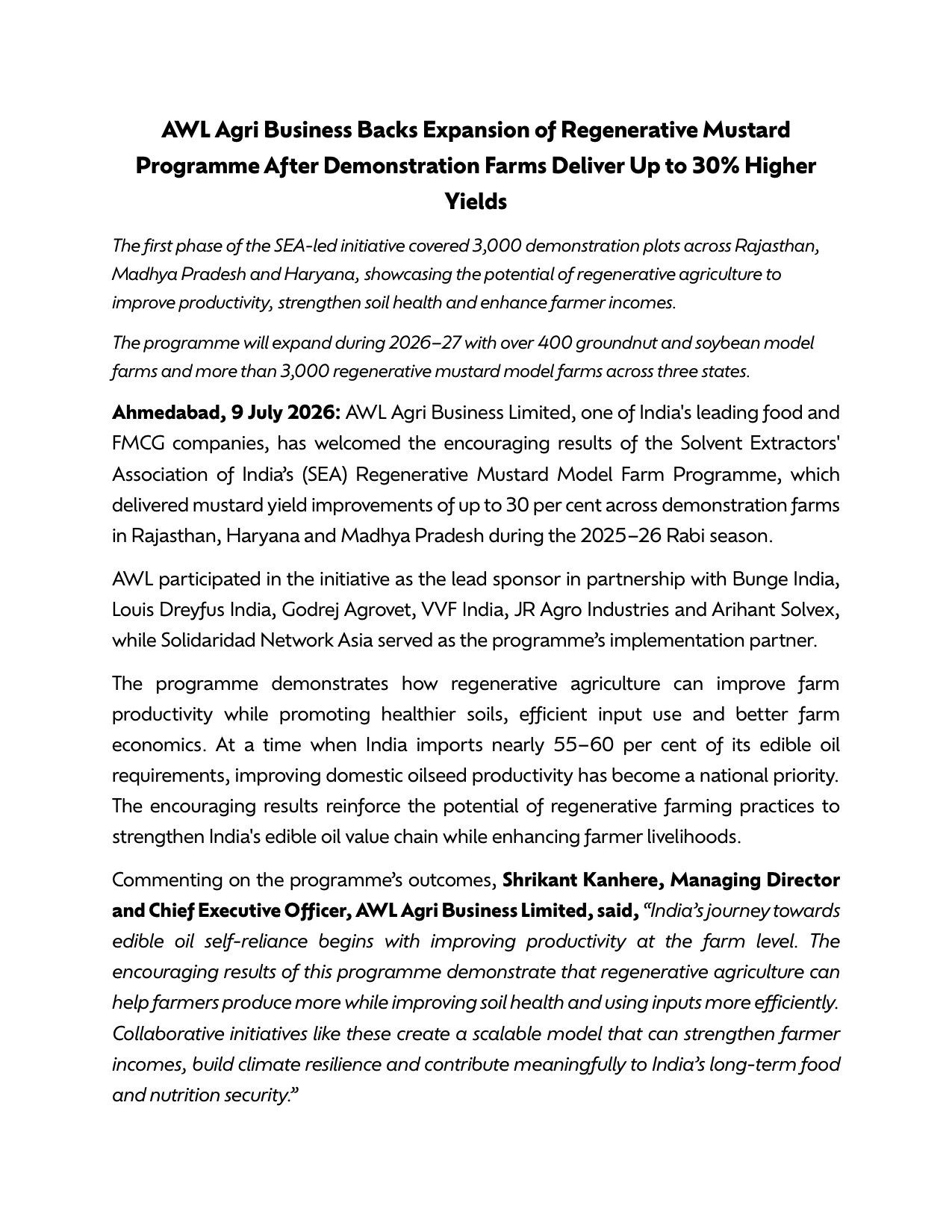
AWL Agri Business Limited has announced the expansion of the SEA-led Regenerative Mustard Programme after demonstration farms recorded yield improvements of up to 30% during the 2025-26 Rabi season. The next phase will expand regenerative farming initiatives across mustard, soybean, and groundnut crops to strengthen domestic oilseed production, improve farmer incomes, and support India’s edible oil self-reliance objectives.
PRICE-SENSITIVE TRIGGER
Event: Expansion of the Regenerative Mustard Programme following successful demonstration farm outcomes.
Type: Agricultural Development
Impact: Positive
Immediate Effect: The company will support the expansion of regenerative farming through additional model farms across Rajasthan, Madhya Pradesh, and Haryana, reinforcing sustainable agriculture and domestic oilseed productivity.
Financials:
Key Metrics:
- Demonstration Farms (2025-26): 3,000 Front Line Demonstration (FLD) plots
- States Covered: Rajasthan, Haryana and Madhya Pradesh
- Maximum Yield Improvement: Up to 30%
- Rajasthan Yield: 1,853 kg/ha → 2,409 kg/ha (+30%)
- Haryana Yield: 1,900 kg/ha → 2,470 kg/ha (+30%)
- Madhya Pradesh Yield: 1,900 kg/ha → 2,295 kg/ha (+20.5%)
- Expansion (2026-27):
- More than 400 regenerative groundnut and soybean model farms
- More than 3,000 regenerative mustard model farms
Highlight:
- Programme Outcome: Demonstration farms delivered yield improvements of up to 30%, validating regenerative agriculture as a scalable approach for improving farm productivity and sustainability.
What Happened ?
AWL Agri Business announced encouraging results from the Solvent Extractors’ Association of India (SEA) Regenerative Mustard Model Farm Programme, where demonstration farms achieved significantly higher mustard yields through regenerative agricultural practices.
Following the successful first phase, the programme will be expanded during FY2026-27 with additional regenerative model farms for mustard, soybean, and groundnut across three states.
Key details
Programme Expansion and Operational Highlights:
- The first phase covered 3,000 demonstration plots across 14 districts in Rajasthan, Haryana and Madhya Pradesh.
- AWL participated as the lead sponsor alongside Bunge India, Louis Dreyfus India, Godrej Agrovet, VVF India, JR Agro Industries and Arihant Solvex.
- Solidaridad Network Asia served as the implementation partner.
- Regenerative farming practices focused on:
- Improved soil health management
- Balanced nutrient application
- Sustainable cultivation practices
- Climate-resilient agriculture
- The initiative is supported by 27 Farmer Field Schools, enabling farmer training and knowledge sharing.
- During FY2026-27, the programme will expand with:
- More than 400 regenerative groundnut and soybean model farms during the Kharif season.
- More than 3,000 regenerative mustard model farms during the Rabi season.
- The expansion aligns with the Government of India’s National Mission on Edible Oils–Oilseeds (NMEO-OS) to improve domestic oilseed production and reduce dependence on imports.
Note:
- India currently imports nearly 55–60% of its edible oil requirements. The programme aims to improve domestic productivity while enhancing soil health, resource efficiency, and farmer profitability through regenerative farming practices.
Risk Analysis
Summary:
- The announcement relates to an agricultural sustainability programme rather than a commercial order or financial transaction. Its long-term benefits depend on successful farmer adoption, programme execution, and continued productivity improvements.
Key Risks:
- Adoption of regenerative farming practices may vary across regions.
- Weather conditions and crop performance can affect programme outcomes.
- Long-term productivity improvements require sustained farmer participation.
- The initiative does not provide immediate revenue or earnings impact.
Worst Case:
- If adoption remains limited or agronomic outcomes weaken due to climatic factors, the programme’s contribution to domestic oilseed production and farmer income improvement may be lower than expected.
Risk Level: Low
Company Commentary
- AWL stated that improving farm productivity is essential to achieving India’s edible oil self-reliance.
- Management believes regenerative agriculture can simultaneously increase yields, improve soil health, enhance input efficiency, and strengthen farmer incomes.
- The company will continue supporting science-based agricultural initiatives with industry partners to build a resilient edible oil ecosystem.
- AWL reaffirmed its commitment to promoting sustainable farming and creating long-term value for farming communities across India.
Official Exchange Filing: AWL Agri Business Limited