Business Expansion / Partnership
Jupiter Electric Mobility Secures Strategic BESS MoUs; Targets ₹200 Crore Order Book in FY27
NSE
jwl
BSE
533272
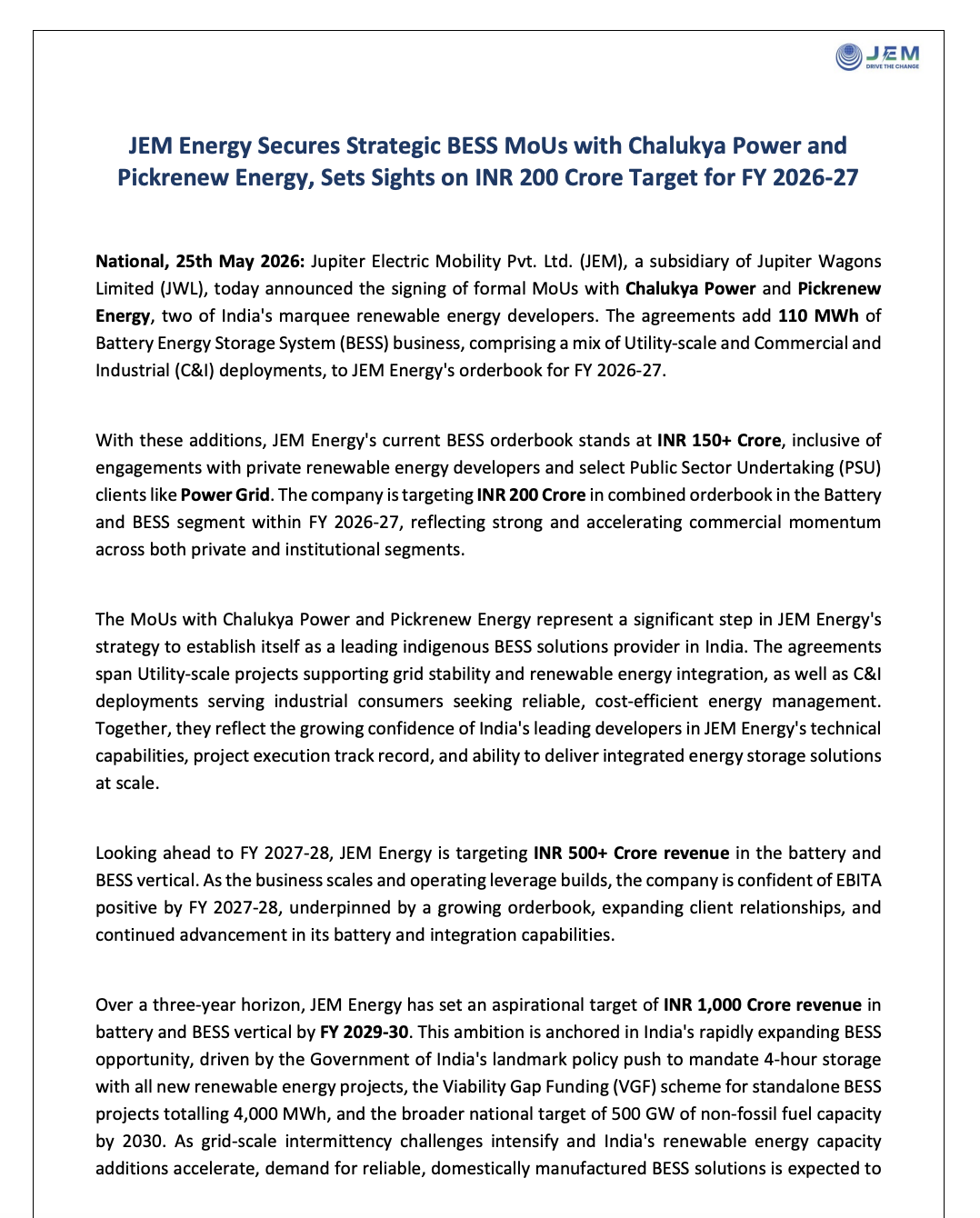
Jupiter Electric Mobility (JEM), a subsidiary of Jupiter Wagons Limited, signed strategic MoUs with Chalukya Power and Pickrenew Energy for Battery Energy Storage System (BESS) projects totaling 110 MWh. The company stated that its BESS order book has crossed ₹150 crore and is targeting ₹200 crore in FY2026-27, alongside long-term ambitions of ₹1,000 crore revenue from the BESS vertical by FY2030.
PRICE-SENSITIVE TRIGGER
Event: Strategic BESS MoUs and Order Book Expansion
Type: Business Expansion / Partnership
Impact: Positive
Immediate Effect: The agreements strengthen Jupiter Wagons’ energy storage business pipeline and improve visibility for growth in utility-scale and commercial & industrial battery storage deployments.
Key Metrics:
Current BESS Order Book:
- Existing BESS order book:
- ₹150+ crore
- FY2026-27 targeted combined order book:
- ₹200 crore
Medium-Term Revenue Targets:
- FY2027-28 battery and BESS revenue target:
- ₹500+ crore
- FY2029-30 battery and BESS revenue aspiration:
- ₹1,000 crore
Project Additions:
- New BESS capacity added through MoUs:
- 110 MWh
Investment & Market Expansion Commentary:
- Utility-scale and C&I deployments expected to contribute meaningfully to future revenue visibility.
Highlight:
- JEM Energy secured 110 MWh BESS engagements while outlining a multi-year scale-up roadmap targeting ₹1,000 crore revenue by FY2030.
What Happened ?
Jupiter Electric Mobility Pvt. Ltd. (JEM), a subsidiary of Jupiter Wagons Limited, announced the signing of formal MoUs with Chalukya Power and Pickrenew Energy for Battery Energy Storage System (BESS) deployments.
The agreements collectively add 110 MWh of BESS business comprising:
- Utility-scale energy storage projects
- Commercial & Industrial (C&I) deployments
The company stated that these additions increase JEM Energy’s current BESS order book to more than ₹150 crore for FY2026-27.
Management also outlined aggressive scale-up plans for the battery and energy storage vertical, targeting:
- ₹200 crore order book in FY27
- ₹500+ crore revenue by FY28
- ₹1,000 crore revenue ambition by FY30
The development marks a strategic push by Jupiter Wagons into India’s rapidly expanding renewable energy storage ecosystem.
Key Details
Business Expansion and Strategic Positioning:
- The MoUs strengthen JEM Energy’s positioning in:
- Grid-scale energy storage
- Renewable integration
- Industrial energy management solutions
- The projects cover:
- Utility-scale BESS deployments
- Commercial & Industrial applications
- JEM highlighted increasing policy support for:
- Renewable energy storage
- Grid balancing infrastructure
- Domestic battery manufacturing
- Management referenced India’s:
- 500 GW non-fossil fuel target by 2030
- Viability Gap Funding (VGF) support for standalone BESS projects
- Mandates for storage-linked renewable projects
- The company indicated strong confidence in:
- Technical execution capability
- Integrated energy storage solutions
- Indigenous manufacturing capability
- JEM Energy operates within Jupiter Wagons’ broader mobility and infrastructure ecosystem, leveraging engineering and manufacturing expertise.
Strategic Importance:
- The announcement diversifies Jupiter Wagons beyond rail and mobility products into clean energy infrastructure.
- The BESS vertical can create:
- Recurring infrastructure opportunities
- Higher-growth adjacencies
- Long-duration project pipeline visibility
- Energy storage is emerging as a critical enabler for:
- Renewable integration
- Grid stability
- Industrial power optimization
- The company’s integrated approach across:
- Battery technology
- System integration
- Project execution
may support long-term competitive positioning.
Risk Analysis
Summary:
- Execution scalability, project conversion timelines, and evolving competitive dynamics in the energy storage sector remain key monitoring factors.
Key Risks:
- MoUs do not necessarily guarantee immediate revenue realization.
- Large-scale BESS deployment involves:
- Technology risks
- Supply chain dependencies
- Capital intensity
- Margin sustainability will depend on:
- Execution quality
- Battery sourcing economics
- Project profitability
- The sector remains exposed to:
- Policy changes
- Raw material price volatility
- Competitive pricing pressure
- Aggressive long-term revenue targets require:
- Strong order conversion
- Manufacturing scalability
- Consistent project execution
Worst Case Scenario:
- Delays in project execution, slower order conversion, or margin pressure in the battery storage segment could weaken the company’s targeted growth trajectory.
Risk Level: Medium
Company Commentary
Vivek Lohia, Managing Director, Jupiter Wagons Limited:
- Management stated the MoUs validate JEM Energy’s growing stature in India’s energy storage sector.
- The company highlighted:
- ₹150+ crore order book visibility
- ₹200 crore FY27 target
- Long-term ₹1,000 crore vision for the BESS vertical
- Management emphasized:
- Deep technology capability
- Reliable execution
- Long-term partnerships with developers
Kartik Hajela, CEO, JEM Energy:
- The company described the agreements as:
- Long-term strategic partnerships
- Not merely transactional engagements
- Management indicated focus on:
- Scalable project execution
- Reliability and quality
- Building long-term capability within energy storage solutions
- JEM reiterated confidence in scaling:
- Revenue visibility
- Client relationships
- Operational momentum
Official Exchange Filing: Jupiter Wagons Limited