Quarterly Financial Results
Kross Limited Reports Strong Q1 FY27 Growth as Revenue Rises 32% and EBITDA Climbs 39% on Capacity Expansion
NSE
kross
BSE
544253
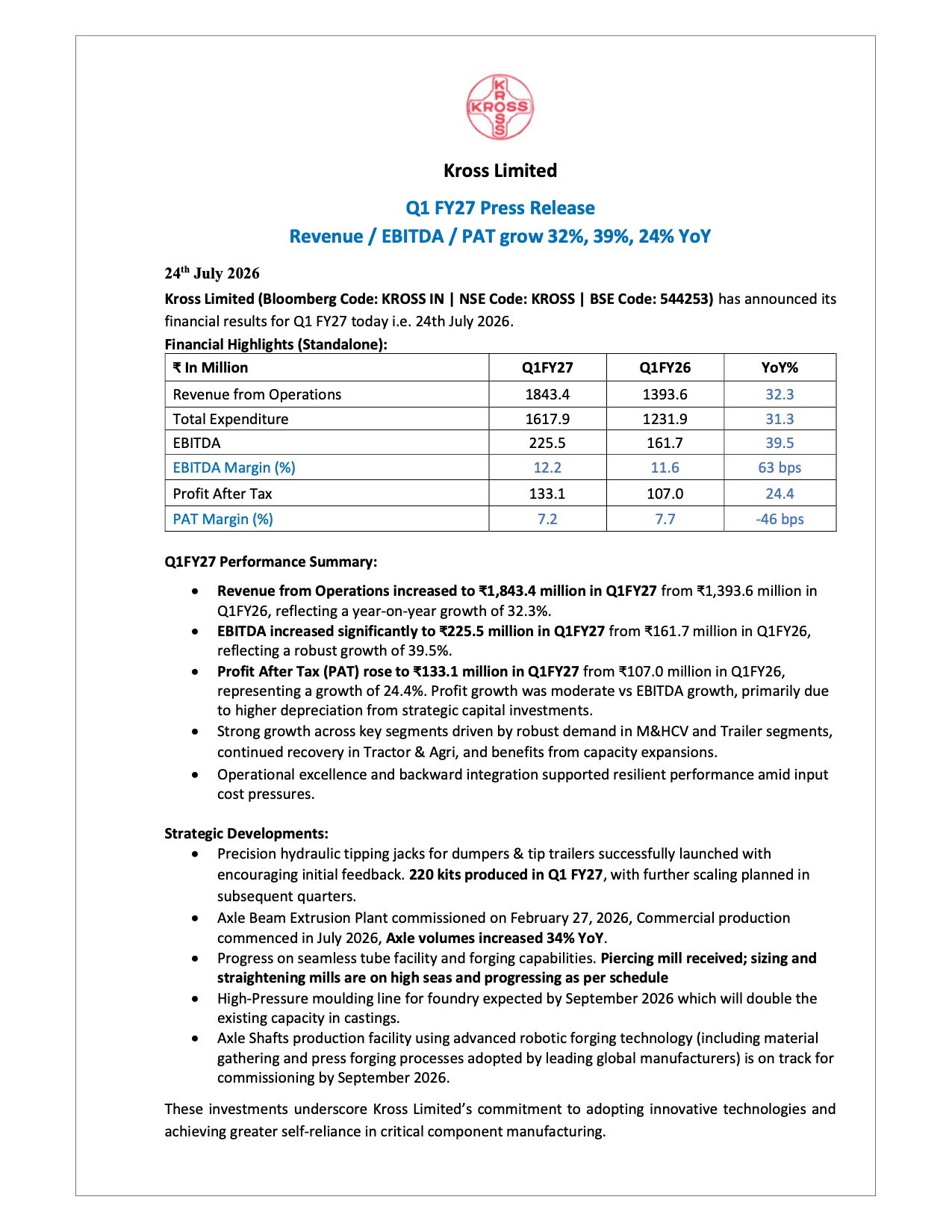
- Kross Limited delivered a strong operational performance in Q1 FY27, reporting 32.3% year-on-year growth in revenue, 39.5% growth in EBITDA and a 24.4% increase in profit after tax.
- Growth was driven by robust demand across Medium & Heavy Commercial Vehicles (M&HCV), trailer and tractor segments, supported by capacity expansion, backward integration and operational efficiencies.
- The company also advanced several strategic manufacturing projects that are expected to strengthen long-term growth and self-reliance in critical automotive components.
PRICE-SENSITIVE TRIGGER
Event: Kross Limited announced its standalone financial results and business update for the quarter ended 30 June 2026.
Type: Quarterly Financial Results
Impact: Positive
Immediate Effect: The company reported broad-based growth in revenue and operating profit while continuing to invest in new manufacturing capabilities. Multiple capacity expansion projects progressed during the quarter, positioning Kross for higher production volumes and stronger vertical integration over the coming quarters.
Metrics:
Key Financial Metrics:
- Revenue from Operations: ₹1,843.4 million (▲32.3% YoY)
- Total Expenditure: ₹1,617.9 million (▲31.3% YoY)
- EBITDA: ₹225.5 million (▲39.5% YoY)
- EBITDA Margin: 12.2% (vs. 11.6% in Q1 FY26)
- Margin Expansion: 63 basis points YoY
- Profit After Tax (PAT): ₹133.1 million (▲24.4% YoY)
- PAT Margin: 7.2% (vs. 7.7% in Q1 FY26)
Highlight:
- Revenue growth of over 32% combined with a 39.5% increase in EBITDA demonstrates improving operating leverage and strong execution across core automotive segments.
- While PAT growth remained lower than EBITDA growth due to higher depreciation arising from strategic capital investments, profitability continued to improve on an absolute basis.
What Happened ?
Kross Limited began FY27 with another quarter of strong business momentum, benefiting from healthy demand across commercial vehicles, trailers and agricultural equipment. Revenue growth was supported by capacity expansion, improving product demand and continued operational efficiency.
Operating profitability improved faster than revenue as the company leveraged higher production volumes, backward integration and manufacturing efficiencies. However, profit after tax grew at a relatively slower pace because recently commissioned capital projects resulted in higher depreciation expenses.
Beyond quarterly financial performance, Kross continued executing multiple strategic manufacturing investments, including new axle, forging, seamless tube and foundry facilities, which are expected to expand production capacity and improve value addition over the medium term.
Business Performance
Revenue & Profitability:
- Revenue from operations increased 32.3% YoY to ₹1,843.4 million.
- EBITDA grew 39.5% YoY, outperforming revenue growth.
- EBITDA margin improved by 63 basis points to 12.2%.
- PAT increased 24.4% YoY to ₹133.1 million.
- Higher depreciation from strategic capital investments moderated PAT growth despite stronger operating performance.
Segment Performance:
Growth remained broad-based across key end markets.
- Strong demand continued in the Medium & Heavy Commercial Vehicle (M&HCV) segment.
- Trailer components recorded healthy business momentum.
- Tractor and agricultural equipment demand continued its recovery.
- Capacity expansion initiatives further supported production growth across major product categories.
Operational Efficiency:
Operational improvements remained an important contributor to earnings growth.
- Backward integration supported better cost control despite input cost pressures.
- Manufacturing efficiencies enabled EBITDA to grow faster than revenue.
- Investments in automation and advanced manufacturing technologies continued to strengthen operational capabilities.
Strategic Developments:
Kross made significant progress on multiple expansion projects during the quarter.
- Successfully launched precision hydraulic tipping jacks for dumpers and tip trailers.
- Produced 220 hydraulic tipping kits during Q1 FY27, with further scale-up planned.
- Commercial production commenced at the Axle Beam Extrusion Plant in July 2026 following commissioning in February 2026.
- Axle volumes increased 34% YoY.
- The seamless tube manufacturing project progressed, with the piercing mill received and sizing and straightening mills in transit.
- A new high-pressure moulding line is expected to become operational by September 2026, doubling foundry casting capacity.
- The robotic forging-based axle shaft production facility remains on schedule for commissioning by September 2026.
Capital Investment Strategy:
The company’s ongoing investments are aimed at strengthening manufacturing integration and reducing dependence on external suppliers.
These initiatives include:
- Expansion of forging capabilities.
- Higher casting capacity.
- Seamless tube manufacturing.
- Advanced robotic axle shaft production.
- Increased self-reliance in safety-critical automotive components.
Management believes these investments will improve competitiveness while supporting long-term revenue growth and profitability.
Note:
- Q1 FY27 demonstrates that Kross is benefiting from both cyclical demand recovery and structural capacity expansion.
- While higher depreciation temporarily moderated earnings growth, the company’s continued investment in advanced manufacturing, backward integration and new product development positions it to capture future demand across commercial vehicle and off-highway equipment markets.
Risk Analysis
Summary:
- Kross continues to benefit from favourable demand trends and expanding manufacturing capacity. However, the business remains exposed to automotive industry cycles, execution risks associated with new projects and raw material cost fluctuations.
Key Risks:
- Commercial vehicle and tractor demand remain sensitive to economic activity.
- Delays in commissioning new manufacturing facilities could postpone expected capacity benefits.
- Raw material price volatility may affect operating margins.
- Higher depreciation from recent capital expenditure may continue to influence short-term earnings growth.
- Scaling newly launched products successfully will be important for sustaining future revenue growth.
Worst Case:
- If automotive demand weakens while new capacity additions experience execution delays or lower-than-expected utilization, revenue growth and profitability could moderate despite higher capital investments.
Risk Level: Medium
Company Commentary
- Chairman & Managing Director Sudhir Rai stated that the company delivered a strong start to FY27 through robust revenue growth, healthy margin expansion and continued investments in innovation and manufacturing capabilities.
- Management highlighted that operational efficiency, strategic capacity expansion and growing demand across key automotive segments have strengthened Kross’ competitive positioning. The company expects these initiatives, together with healthy execution visibility and contributions from new products, to support sustainable revenue growth, improved profitability and long-term shareholder value creation.
Official Exchange Filing: Kross Limited