Capacity Expansion
Maruti Suzuki Commences Production at Fourth Hansalpur Plant, Capacity Rises to 2.9 Million Units
NSE
deepakfert
BSE
500645
- Maruti Suzuki India Limited has commenced commercial production at the fourth manufacturing plant (Plant D) at its Hansalpur facility in Gujarat.
- The new plant adds an annual production capacity of 250,000 units, taking the Hansalpur facility’s capacity to 1 million units and the company’s total manufacturing capacity in India to 2.9 million units per annum.
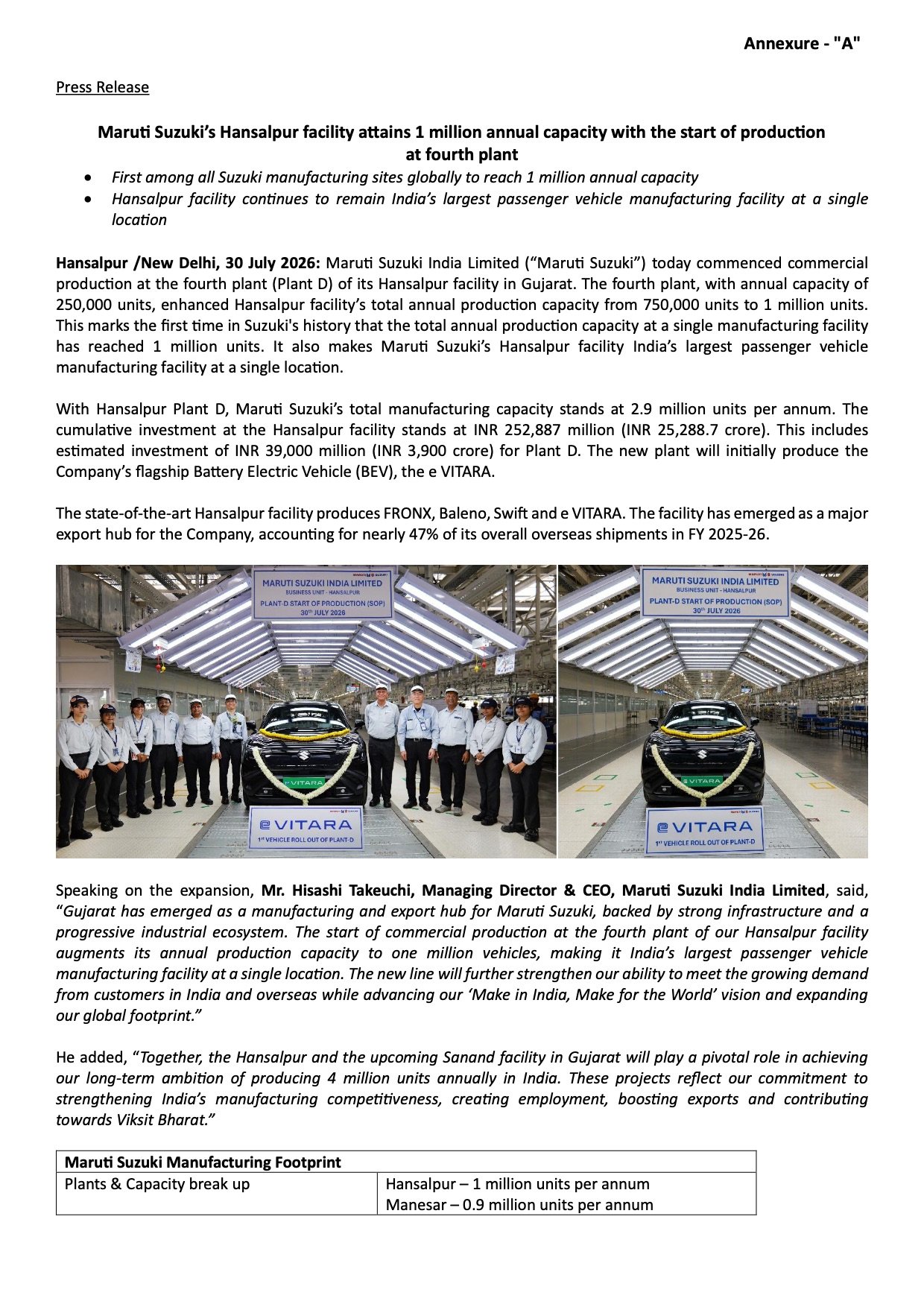
- The facility will initially manufacture the e VITARA Battery Electric Vehicle (BEV).
PRICE-SENSITIVE TRIGGER
Event: Commencement of commercial production at the fourth plant (Plant D) of the Hansalpur manufacturing facility.
Type: Capacity Expansion
Impact: Positive
Immediate Effect: The commissioning increases Maruti Suzuki’s annual production capacity by 250,000 units, strengthens its manufacturing footprint, and enhances its ability to meet domestic and export demand.
Metrics:
- Capacity Added: 250,000 units per annum
- Hansalpur Facility Capacity: Increased from 750,000 to 1 million units per annum
- Total Maruti Suzuki Manufacturing Capacity: 2.9 million units per annum
- Total Investment at Hansalpur: ₹25,288.7 crore
- Estimated Investment in Plant D: ₹3,900 crore
Highlight:
- Hansalpur becomes Suzuki’s first manufacturing site globally to achieve an annual production capacity of 1 million vehicles.
What Happened ?
Maruti Suzuki India Limited announced the commencement of commercial production at Plant D of its Hansalpur manufacturing facility in Gujarat, effective 30 July 2026.
The newly commissioned plant has an annual production capacity of 250,000 vehicles, increasing Hansalpur’s total capacity to 1 million units per annum. With this expansion, Maruti Suzuki’s aggregate manufacturing capacity across Hansalpur, Manesar, Gurugram and Kharkhoda rises to 2.9 million vehicles annually.
Plant D will initially manufacture the company’s flagship e VITARA Battery Electric Vehicle (BEV), supporting Maruti Suzuki’s electric mobility strategy.
key details
Capacity Expansion Highlights
- Commercial production at Plant D commenced on 30 July 2026.
- New production capacity added: 250,000 units per annum.
- Hansalpur facility capacity increased to 1 million units annually.
- Total company manufacturing capacity increased to 2.9 million units per annum.
- Hansalpur is now India’s largest passenger vehicle manufacturing facility at a single location.
- It is also the first Suzuki manufacturing site globally to achieve 1 million units of annual production capacity.
Manufacturing Footprint
Following the expansion, Maruti Suzuki’s annual manufacturing capacity comprises:
- Hansalpur: 1.0 million units
- Manesar: 0.9 million units
- Gurugram: 0.5 million units
- Kharkhoda: 0.5 million units
Total Capacity: 2.9 million units per annum.
Operational Highlights
- Plant D will initially manufacture the e VITARA Battery Electric Vehicle.
- Hansalpur currently produces FRONX, Baleno, Swift and e VITARA.
- The facility spans 640 acres with an integrated suppliers’ park.
- Total cumulative investment at Hansalpur has reached ₹25,288.7 crore, including ₹3,900 crore invested in Plant D.
- During FY2025-26, Hansalpur accounted for nearly 47% of Maruti Suzuki’s total vehicle exports.
Strategic Importance
- The expansion significantly strengthens Maruti Suzuki’s manufacturing capabilities as it prepares for higher domestic demand and accelerated electric vehicle production.
- Management also indicated that the Hansalpur facility, together with the upcoming Sanand plant, will support the company’s long-term objective of achieving 4 million units of annual production capacity in India while expanding exports under its “Make in India, Make for the World” strategy.
Note:
- The announcement relates solely to the commencement of commercial production and does not include financial guidance or expected revenue contribution from the new facility.
Risk Analysis
Summary:
- The capacity expansion strengthens Maruti Suzuki’s manufacturing base, but future returns will depend on demand for passenger vehicles, particularly electric vehicles, and the successful ramp-up of production.
Key Risks:
- Demand for the e VITARA and other models may vary from expectations.
- Capacity utilization may initially remain below optimal levels.
- EV adoption and competitive intensity could influence production volumes.
- Export demand remains subject to global economic conditions.
Worst Case:
- If vehicle demand weakens or production ramp-up is slower than expected, the additional manufacturing capacity may remain underutilized, affecting return on investment.
Risk Level: Low
Company Commentary
Management Highlights:
- Hansalpur has evolved into a major manufacturing and export hub supported by Gujarat’s industrial ecosystem.
- The fourth plant strengthens Maruti Suzuki’s ability to meet rising domestic and international demand.
- The company remains committed to its “Make in India, Make for the World” vision.
- Hansalpur and the upcoming Sanand facility are expected to play a key role in achieving Maruti Suzuki’s long-term target of producing 4 million vehicles annually in India.
- The projects are expected to strengthen manufacturing competitiveness, generate employment and boost exports.
Official Exchange Filing: Maruti Suzuki India Limited