Product Launch
Maruti Suzuki Launches India’s First Flex-Fuel Passenger Vehicle Based on WagonR Platform
NSE
maruti
BSE
532500
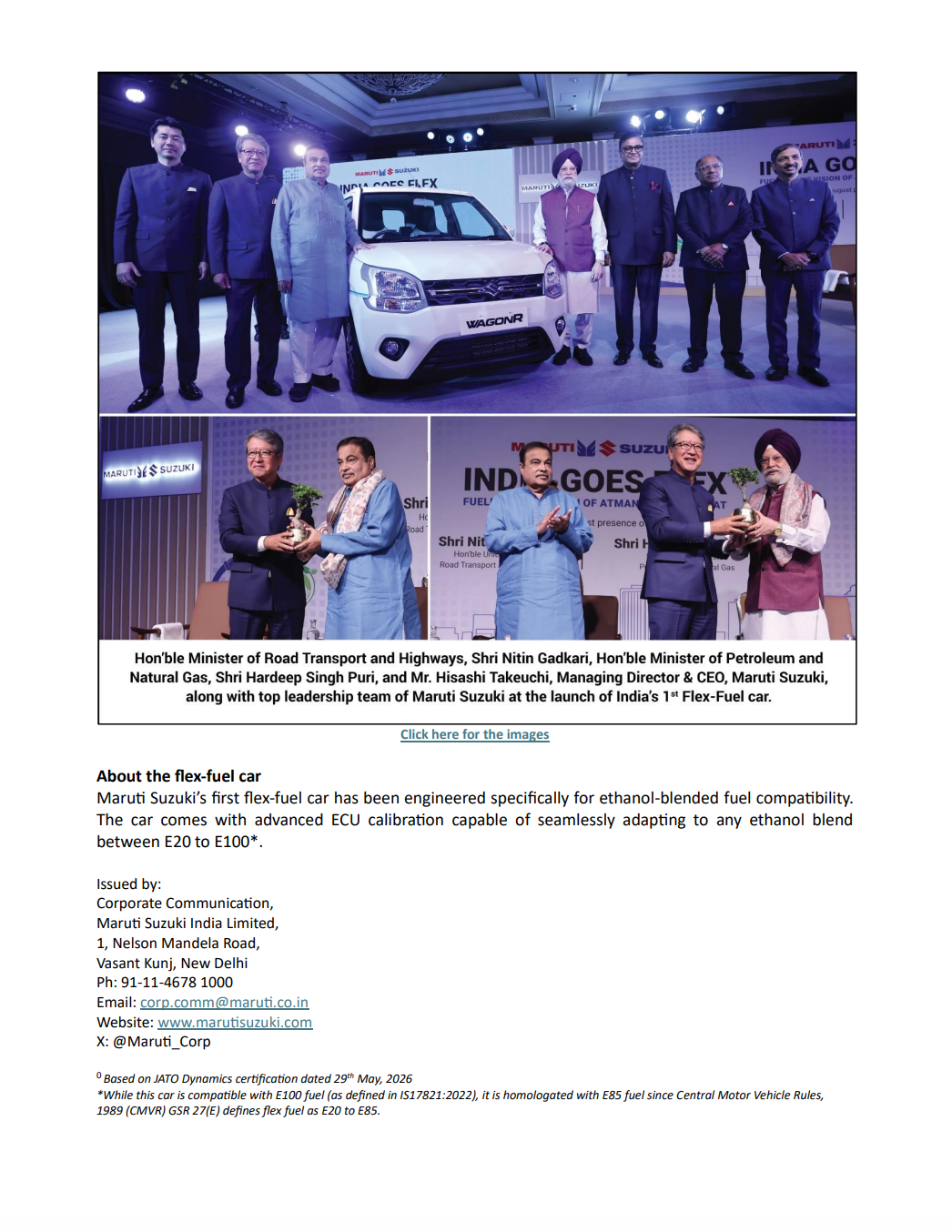
Maruti Suzuki India Limited launched India’s first flex-fuel passenger car, introducing ethanol-flex fuel technology in the WagonR platform. The vehicle is capable of operating on ethanol-petrol blends ranging from E20 to E100, supporting India’s energy security, ethanol adoption, and sustainability objectives while expanding Maruti Suzuki’s alternative fuel portfolio.
PRICE-SENSITIVE TRIGGER
Event: Launch of India’s first flex-fuel passenger vehicle.
Type: Product Launch
Impact: Positive
Immediate Effect: The launch strengthens Maruti Suzuki’s position in alternative fuel mobility solutions and aligns the company with India’s ethanol blending, energy security, and decarbonization initiatives.
Key Metrics:
- No financial figures disclosed in the announcement.
- No revenue, profitability, or investment data provided.
- Product launch focused on technology and strategic positioning.
Highlight:
- India’s first flex-fuel passenger car launched with capability to operate on ethanol blends ranging from E20 to E100.
What Happened ?
Maruti Suzuki India Limited announced the launch of India’s first flex-fuel passenger vehicle in the presence of Union Minister for Road Transport and Highways Nitin Gadkari and Union Minister for Petroleum and Natural Gas Hardeep Singh Puri.
The company introduced flex-fuel technology on the WagonR platform, enabling the vehicle to seamlessly operate on varying ethanol-petrol blends from E20 to E100 through advanced ECU calibration.
The launch forms part of Maruti Suzuki’s broader strategy to diversify fuel technologies alongside CNG, LPG, hybrid, EV, and compressed biogas solutions while supporting India’s transition toward lower crude oil dependence.
Key Details
Flex-Fuel Technology Launch and Strategic Significance:
- Maruti Suzuki launched India’s first flex-fuel passenger car.
- Technology introduced on the WagonR platform.
- Vehicle can operate on ethanol-petrol blends ranging from E20 to E100.
- Advanced ECU calibration automatically adapts to different ethanol blend levels.
- Launch coincides with India’s push toward alternative fuel adoption.
- Flex-fuel vehicles are expected to support reduced crude oil imports.
- Ethanol demand can provide additional support to the agricultural economy.
- Product aligns with India’s energy security and sustainability objectives.
- Maruti Suzuki already maintains a diversified alternative fuel portfolio including CNG and LPG vehicles.
- Company is simultaneously pursuing EVs, hybrids, CNG, compressed biogas and ethanol-based mobility solutions.
- Flex-fuel technology expands the company’s clean mobility offerings.
- Vehicle received certification based on flex-fuel compatibility requirements.
Note:
- The launch positions Maruti Suzuki as the first passenger vehicle manufacturer in India to commercialize flex-fuel technology, potentially creating an early-mover advantage as ethanol infrastructure and adoption expand nationwide.
Risk Analysis
Summary:
- Commercial success of flex-fuel vehicles depends on the development of ethanol distribution infrastructure, consumer adoption, fuel availability, and supportive regulatory policies.
Key Risks:
- Availability of higher ethanol-blended fuel remains limited across many regions.
- Consumer adoption will depend on fuel accessibility and operating economics.
- Expansion of ethanol supply infrastructure is required for large-scale adoption.
- Market acceptance of flex-fuel vehicles remains untested at scale in India.
- Regulatory and fuel policy changes could influence adoption rates.
- Competing technologies such as EVs and hybrids may impact demand.
Worst Case Scenario:
- Limited ethanol infrastructure and slow consumer adoption could restrict commercialization benefits despite the technological leadership demonstrated by the launch.
Risk Level: Medium
Company Commentary
- Maruti Suzuki remains committed to offering vehicles powered by multiple fuel technologies.
- Flex-fuel vehicles are intended to support India’s goals of reducing crude oil imports and carbon emissions.
- Management believes flex-fuel technology can contribute to domestic value creation and higher farmer incomes.
- The company views ethanol as an important component of India’s future mobility ecosystem.
- Flex-fuel technology complements Maruti Suzuki’s broader portfolio of EVs, hybrids, CNG and compressed biogas vehicles.
- The launch supports the vision of “India Go Flex” and greater energy self-reliance.
Official Exchange Filing: Maruti Suzuki India Limited