Manufacturing Capacity Addition
Maruti Suzuki’s Kharkhoda Manufacturing Facility Inaugurated; ₹35,000 Crore Investment to Scale Capacity to 1 Million Vehicles
NSE
maruti
BSE
532500
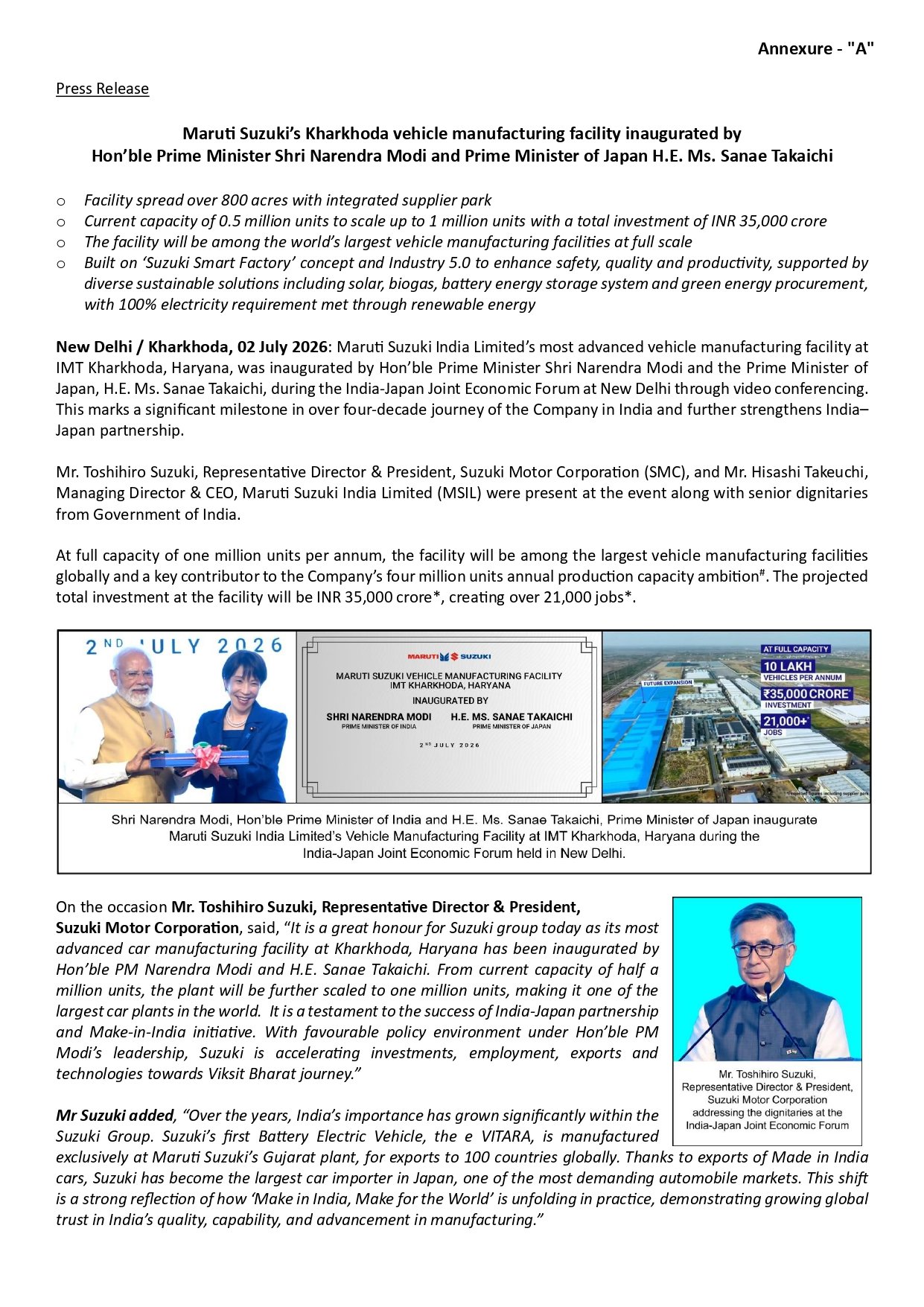
Maruti Suzuki India Limited inaugurated its new vehicle manufacturing facility at Kharkhoda, Haryana. The plant begins operations with an annual production capacity of 0.5 million vehicles, expandable to 1 million vehicles, backed by a planned investment of ₹35,000 crore. The facility incorporates Industry 5.0 technologies, renewable energy integration, and sustainable manufacturing practices.
PRICE-SENSITIVE TRIGGER
Event: Inauguration of Maruti Suzuki’s Kharkhoda vehicle manufacturing facility.
Type: Manufacturing Capacity Addition
Impact: Positive
Immediate Effect: The commissioning of the Kharkhoda facility strengthens Maruti Suzuki’s production network, enhances future manufacturing capacity, and supports long-term domestic and export growth.
Key Metrics:
- Initial Production Capacity: 0.5 million vehicles per annum
- Planned Capacity: 1 million vehicles per annum
- Total Planned Investment: ₹35,000 crore
- Projected Employment: More than 21,000 jobs
- Current Installed Solar Capacity: 20 MWp
- Planned Solar Capacity: 70 MWp by 2030
- Expected Total Manufacturing Capacity by FY2026-27: 2.9 million vehicles annually
Highlight:
- The Kharkhoda facility is designed to become one of the world’s largest automobile manufacturing plants with 1 million units annual capacity supported by ₹35,000 crore of planned investment.
What Happened ?
Maruti Suzuki India Limited inaugurated its newest manufacturing facility at IMT Kharkhoda, Haryana, during the India-Japan Joint Economic Forum. The inauguration was attended by Prime Minister Shri Narendra Modi and Japanese Prime Minister H.E. Ms. Sanae Takaichi via video conferencing.
The facility marks another major milestone in Maruti Suzuki’s manufacturing expansion strategy and strengthens the long-standing India-Japan industrial partnership. Once fully expanded, the plant will significantly increase the company’s production capability while incorporating advanced manufacturing technologies and sustainability initiatives.
Key Details
Manufacturing Expansion:
- Facility spread across over 800 acres with an integrated supplier park.
- Initial production capacity of 5 lakh vehicles annually.
- Expandable to 10 lakh vehicles annually at full scale.
- Expected to become one of the world’s largest vehicle manufacturing facilities.
- Built on Suzuki’s Smart Factory concept with Industry 5.0 technologies.
Capacity Enhancement:
- Kharkhoda contributes to Maruti Suzuki’s long-term production expansion.
- Company expects overall manufacturing capacity to reach 2.9 million vehicles annually by FY2026-27.
- Existing manufacturing footprint:
- Gurugram – 0.5 million units
- Manesar – 0.9 million units
- Hansalpur – 0.75 million units
- Kharkhoda – 0.5 million units
Sustainability Initiatives:
- 100% electricity requirement planned through renewable energy procurement.
- Installed solar generation capacity of 20 MWp, targeted to increase to 70 MWp by 2030.
- Installation of:
- Battery Energy Storage System (BESS)
- 10 TPD biogas plant
- Zero Liquid Discharge (ZLD) manufacturing facility.
- Nearly two-thirds of water requirement met through recycled water and rainwater harvesting.
- Planned in-plant railway siding to improve logistics efficiency and reduce fuel consumption.
Technology & Manufacturing:
- Developed under the Suzuki Smart Factory framework.
- Incorporates Industry 5.0 manufacturing systems.
- Human-aware collaborative robots (COBOTs) deployed for advanced production.
- Real-time operational visualization improves quality, safety and productivity.
- Focus on lower energy consumption and manufacturing efficiency.
Employment & Community Development:
- Project expected to create over 21,000 direct jobs.
- CSR initiatives planned across nearby villages covering:
- Education
- Healthcare
- Sanitation
- Community infrastructure
- Expansion of Japan-India Institutes for Manufacturing (JIMs) to develop skilled manpower.
Note:
- The Kharkhoda facility represents Maruti Suzuki’s next major manufacturing hub designed to support both domestic demand and export opportunities while integrating advanced automation and sustainable production practices.
Risk Analysis
Summary:
- The project strengthens Maruti Suzuki’s manufacturing capabilities but requires successful capacity ramp-up, sustained demand growth and timely execution of future expansion phases.
Key Risks:
- Large capital deployment requires strong long-term demand.
- Ramp-up of production may take time.
- Automotive industry demand cycles could affect capacity utilization.
- Execution of future expansion and renewable infrastructure remains critical.
Worst Case:
- If domestic or export demand weakens, the facility could initially operate below optimal utilization, delaying returns on the planned ₹35,000 crore investment.
Risk Level: Medium
Company Commentary
- The Kharkhoda plant represents Maruti Suzuki’s most advanced manufacturing facility in India.
- The company plans to scale annual production capacity from 0.5 million to 1 million vehicles.
- The facility combines advanced manufacturing technologies with renewable energy and sustainable operations.
- Management believes the project reinforces India’s position as a global automobile manufacturing hub and supports the Make in India initiative.
- The investment reflects Maruti Suzuki’s long-term commitment to manufacturing, exports, employment generation and industrial growth.
Official Exchange Filing: Maruti Suzuki India Limited