Quarterly Financial Results
REC Q1 FY27 Results: PAT Rises 23% QoQ; Declares ₹4.25 Interim Dividend and Loan Book Reaches ₹5.90 Lakh Crore
NSE
recltd
BSE
532955
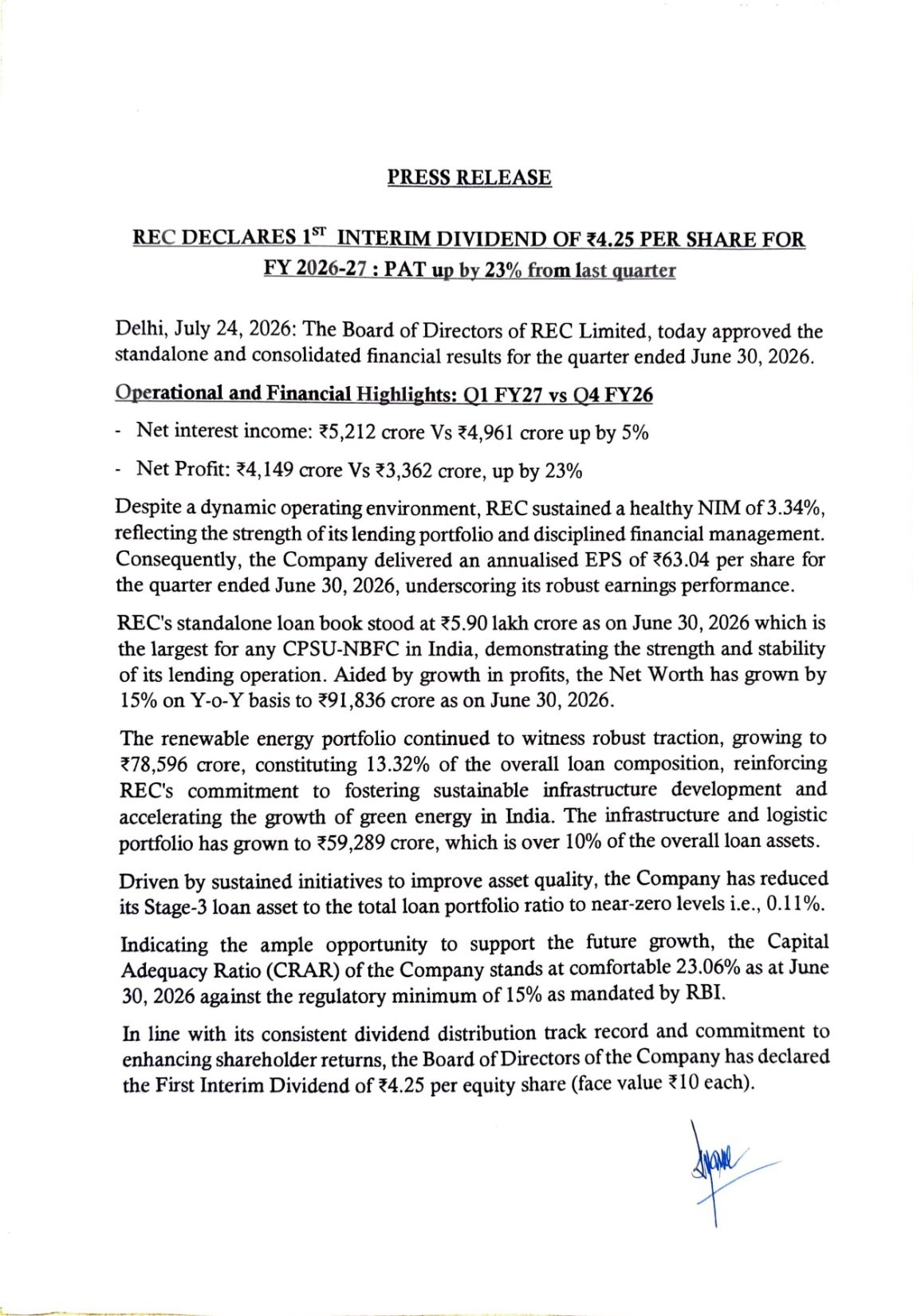
- REC Limited reported a strong start to FY27, with Net Profit increasing 23% QoQ to ₹4,149 crore and Net Interest Income (NII) rising 5% QoQ to ₹5,212 crore.
- The company maintained a healthy Net Interest Margin (NIM) of 3.34%, expanded its standalone loan book to ₹5.90 lakh crore, and declared a first interim dividend of ₹4.25 per equity share.
- Asset quality remained exceptionally strong, with the Stage-3 loan ratio reducing to 0.11%, while capital adequacy stood comfortably above regulatory requirements.
PRICE-SENSITIVE TRIGGER
Event: REC Limited announced its financial results for the quarter ended 30 June 2026 and declared the first interim dividend for FY27.
Type: Quarterly Financial Results
Impact: Positive
Immediate Effect: The company reported higher quarterly profitability, continued balance sheet expansion, excellent asset quality and rewarded shareholders with an interim dividend of ₹4.25 per share.
Metrics:
Key Financial Metrics:
- Net Interest Income (NII): ₹5,212 crore (▲5% QoQ)
- Net Profit (PAT): ₹4,149 crore (▲23% QoQ)
- Net Interest Margin (NIM): 3.34%
- Annualised EPS: ₹63.04
- Standalone Loan Book: ₹5.90 lakh crore
- Net Worth: ₹91,836 crore (▲15% YoY)
- Renewable Energy Portfolio: ₹78,596 crore (13.32% of total loan book)
- Infrastructure & Logistics Portfolio: ₹59,289 crore (Over 10% of loan assets)
- Stage-3 Loan Ratio: 0.11%
- Capital Adequacy Ratio (CRAR): 23.06% (Regulatory requirement: 15%)
- Interim Dividend: ₹4.25 per equity share (Face Value ₹10)
Highlight:
- REC achieved strong earnings growth while maintaining near-zero stressed assets, a robust capital position and India’s largest standalone loan book among CPSU-NBFCs.
What Happened ?
REC Limited delivered a healthy improvement in profitability during Q1 FY27, supported by growth in lending operations, disciplined financial management and stable net interest margins.
The company continued expanding its infrastructure financing portfolio while strengthening its renewable energy exposure. Improvement in the financial health of Indian power utilities also contributed to lower provisioning requirements and better asset quality, enabling REC to sustain strong earnings and declare an interim dividend for shareholders.
key details
Business Performance & Operational Highlights:
- Net Interest Income increased 5% sequentially to ₹5,212 crore.
- Net Profit rose 23% over the previous quarter to ₹4,149 crore.
- Net Interest Margin remained healthy at 3.34%.
- Annualised Earnings Per Share stood at ₹63.04.
- Standalone loan book expanded to ₹5.90 lakh crore, the largest among CPSU-NBFCs in India.
- Net Worth increased 15% YoY to ₹91,836 crore.
- Renewable energy financing reached ₹78,596 crore, accounting for 13.32% of the overall loan portfolio.
- Infrastructure & logistics financing grew to ₹59,289 crore, contributing more than 10% of total loan assets.
- Stage-3 loan assets declined to just 0.11% of the total loan portfolio, reflecting continued improvement in asset quality.
- Capital Adequacy Ratio remained strong at 23.06%, significantly above the RBI’s minimum regulatory requirement of 15%.
- The Board declared the first interim dividend of ₹4.25 per equity share for FY27.
Note:
- REC continues to benefit from improving credit quality across the Indian power sector while steadily diversifying its lending portfolio.
- Strong capitalization, expanding renewable energy financing and disciplined lending practices position the company well to support future infrastructure development and maintain sustainable earnings growth.
Risk Analysis
Summary:
- REC maintains a strong balance sheet and excellent asset quality, but future growth remains linked to credit demand, interest rate movements and execution across infrastructure and renewable energy financing.
Key Risks:
- Lending growth depends on sustained infrastructure investment.
- Interest rate changes could influence lending spreads and profitability.
- Renewable energy financing requires effective project execution and timely repayments.
- Asset quality needs to remain stable as the loan portfolio continues to expand.
- The company continues to rationalize lending rates to pass on the benefits of improved credit profiles to borrowers, which could influence lending yields over time.
Worst Case:
- A slowdown in infrastructure investments or deterioration in borrower credit quality could moderate loan growth and profitability despite REC’s strong capital base and exceptionally low stressed assets.
Risk Level: Low
Company Commentary
- Management highlighted REC’s ability to maintain healthy profitability despite a dynamic operating environment through disciplined financial management.
- The company emphasized continued expansion in renewable energy and infrastructure financing as key long-term growth drivers.
- REC stated that improving financial health of Indian power utilities has strengthened borrower credit profiles and reduced provisioning requirements.
- The company reaffirmed its commitment to supporting Government of India’s power, renewable energy and infrastructure development initiatives while creating long-term shareholder value.
- REC also highlighted its recent recognition with the ‘NBFC of the Year’ Award and the ‘AI & GenAI Adoption Excellence Award’ for business performance and digital innovation.
Official Exchange Filing: REC Limited