Quarterly Financial Results
SAIL Reports Strong Q1 FY27 Earnings with 139% YoY Growth in PAT, Higher EBITDA and Improved Margins
NSE
sail
BSE
500113
- Steel Authority of India Limited (SAIL) reported a sharp improvement in profitability for Q1 FY27, supported by stronger operating performance and better margins despite sequential moderation in revenue.
- The company posted a 139% year-on-year jump in profit after tax, improved EBITDA margin to 16.7%, reduced finance costs and maintained a healthy balance sheet while continuing to benefit from robust domestic steel demand.
PRICE-SENSITIVE TRIGGER
Event: SAIL announced its Q1 FY27 financial results along with its quarterly operational and investor presentation.
Type: Quarterly Financial Results
Impact: Positive
Immediate Effect: The results reflect significant year-on-year improvement in profitability, stronger operating margins, reduced borrowing costs and continued financial stability despite softer sequential sales volumes.
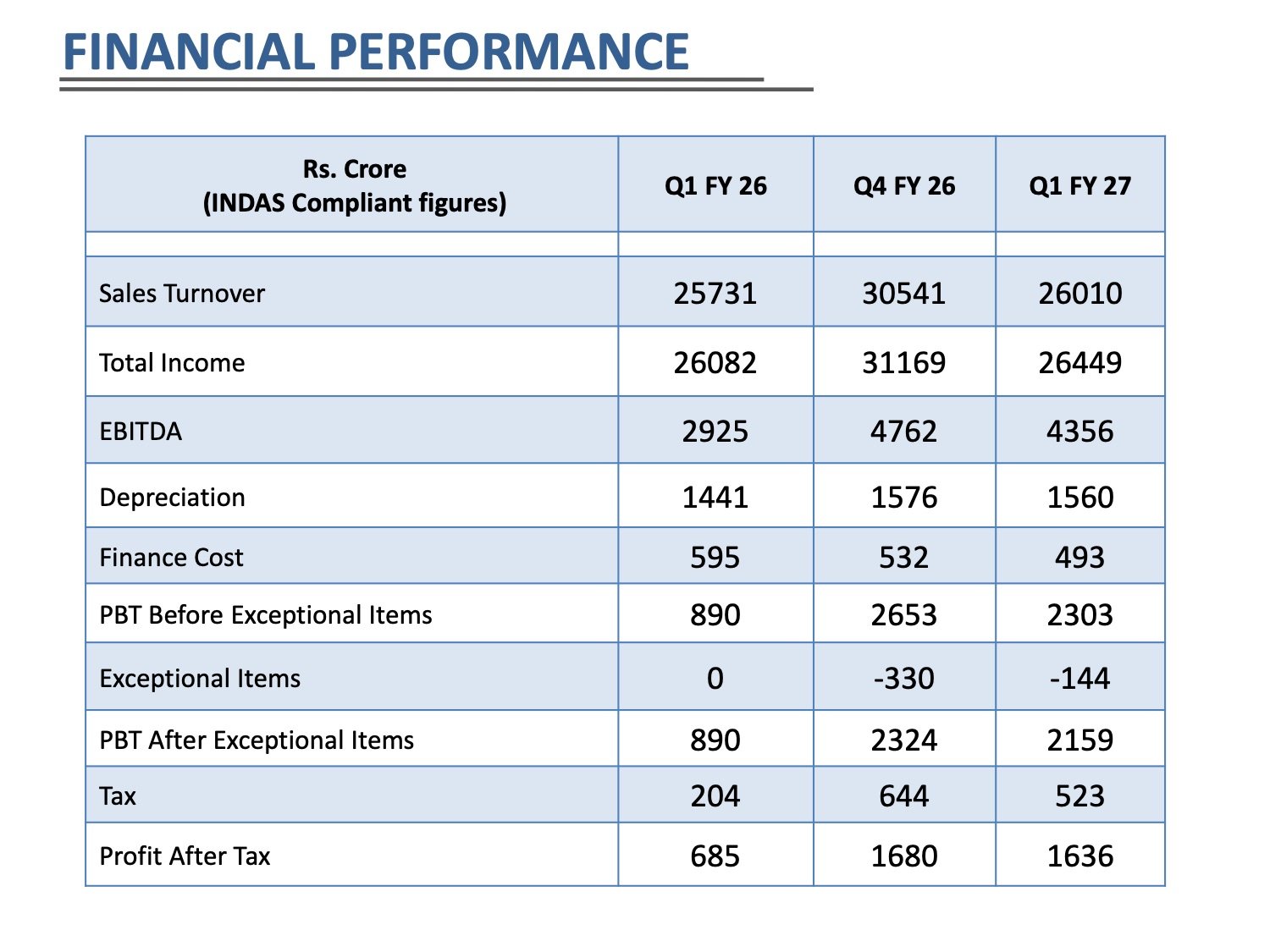
Metrics:
Key Financial Metrics:
- Revenue from Operations: ₹26,246 crore
- Sales Turnover: ₹26,010 crore
- Total Income: ₹26,449 crore
- EBITDA: ₹4,356 crore
- EBITDA Margin: 16.7%
- Profit Before Tax: ₹2,159 crore
- Profit After Tax: ₹1,636 crore
- EPS: ₹3.96
- Net Worth: ₹59,720 crore
- Debt (Ind AS): ₹31,970 crore
- Debt-Equity Ratio: 0.54
- Interest Coverage Ratio: 4.80
- DSCR: 1.66
- Finance Cost: ₹493 crore
- Total Steel Sales: 4.163 million tonnes
- Domestic Sales: 4.106 million tonnes
- Exports: 0.057 million tonnes
- Crude Steel Production: 4.757 million tonnes
- Saleable Steel Production: 4.516 million tonnes
Highlight:
- PAT increased to ₹1,636 crore in Q1 FY27 from ₹685 crore in Q1 FY26, representing nearly 139% year-on-year growth, while EBITDA rose to ₹4,356 crore with EBITDA margin improving to 16.7%.
What Happened ?
SAIL delivered a substantially stronger first quarter compared with the corresponding period last year as higher operating profitability translated into significant earnings growth. While revenue remained broadly stable, improved cost efficiencies, lower finance expenses and stronger EBITDA helped drive higher profit before tax and net profit.
Operationally, the company maintained steel production above 4.7 million tonnes and domestic sales remained the primary revenue contributor, reflecting sustained demand from the Indian steel market. The balance sheet also strengthened further through higher net worth and controlled leverage.
key details
Operational Performance:
- Crude steel production stood at 4.757 million tonnes during Q1 FY27.
- Saleable steel production reached 4.516 million tonnes.
- Total steel sales were 4.163 million tonnes, with domestic sales accounting for over 98% of volumes.
- Iron ore production reached 10.410 million tonnes, supporting captive raw material availability.
- EBITDA increased sharply over the corresponding quarter last year, reflecting stronger operational efficiency.
- Finance cost declined to ₹493 crore, improving overall profitability.
- Net worth increased to ₹59,720 crore, supporting financial flexibility.
- The company continued improving techno-economic parameters, including blast furnace productivity and coal dust injection rates.
Note:
- Management highlighted that India’s steel demand remains resilient, with domestic finished steel consumption growing around 8% during Q1 FY27 compared with approximately 3% growth in crude steel production, indicating favourable demand conditions for domestic producers.
Risk Analysis
Summary:
- Although operational performance improved significantly, SAIL continues to operate within a cyclical global steel industry where profitability remains sensitive to commodity prices and steel demand.
Key Risks:
- International steel prices remain volatile.
- Iron ore and coking coal prices continue to fluctuate.
- Global oversupply, particularly from China, may pressure steel pricing.
- Domestic steel demand growth remains dependent on infrastructure and capital expenditure.
- Sequential decline in quarterly sales volumes indicates near-term demand variability.
Worst Case:
- A prolonged decline in steel prices combined with higher raw material costs could compress margins and reduce profitability in subsequent quarters.
Risk Level: Medium
Company Commentary
- India is expected to remain among the world’s fastest-growing major economies despite moderating GDP projections.
- Domestic steel consumption continues to outpace production growth, supporting long-term demand fundamentals.
- SAIL maintained strong operational performance while improving profitability and financial strength.
- The company continues to focus on operational efficiency, cost optimisation and disciplined capital management.
Official Exchange Filing: Steel Authority of India Limited