Clinical Development
Suven Life Sciences Reports Positive Phase-2b Results for Ropanicant in Major Depressive Disorder
NSE
suven
BSE
530239
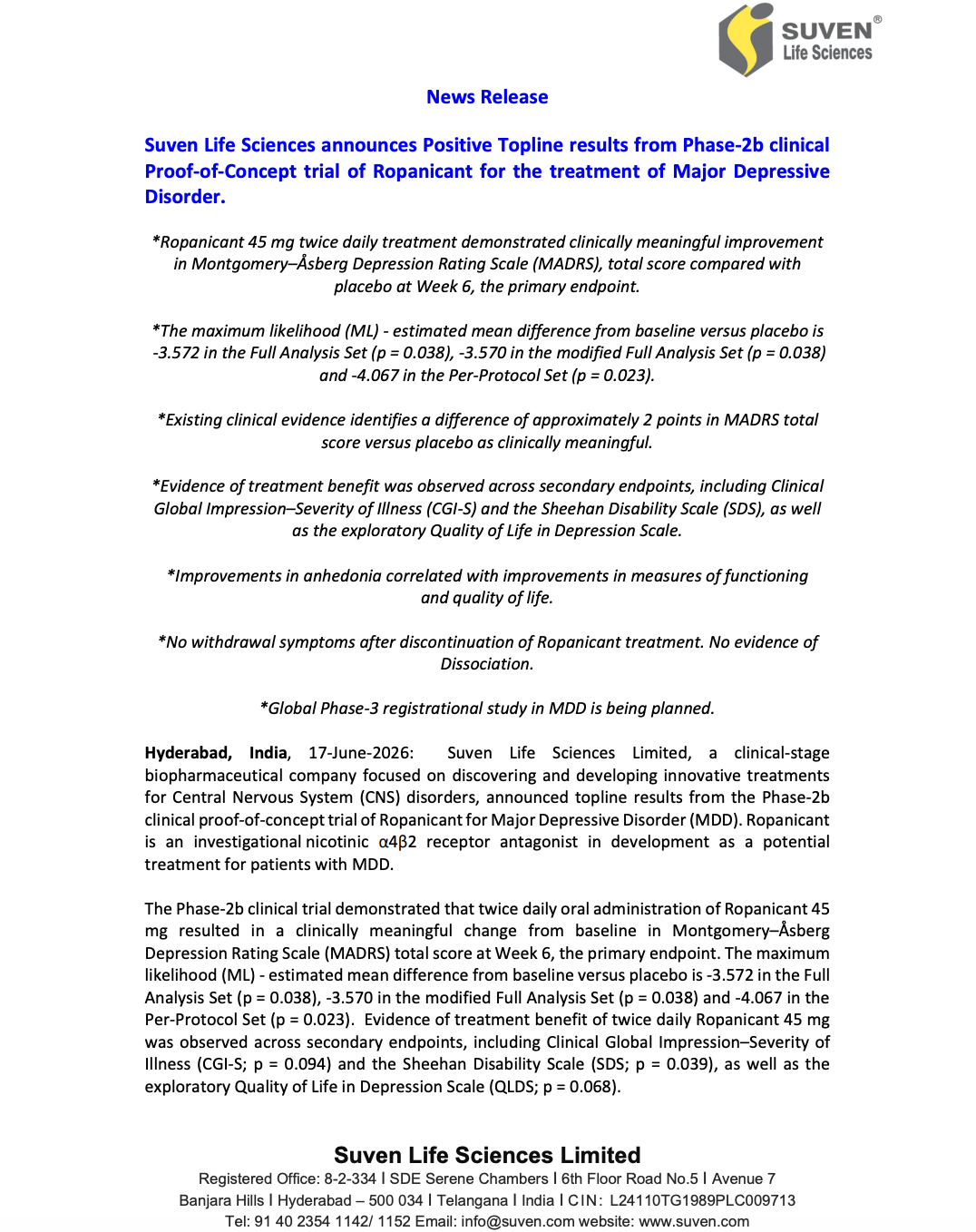
Suven Life Sciences has announced positive topline results from its Phase-2b proof-of-concept clinical trial evaluating Ropanicant (SUVN-911) for Major Depressive Disorder (MDD). The study achieved its primary endpoint with statistically significant improvement in depression symptoms compared to placebo, while also demonstrating favorable safety and tolerability. The company plans to advance the program toward global Phase-3 development.
PRICE-SENSITIVE TRIGGER
Event: Positive topline results from Phase-2b clinical trial of Ropanicant for Major Depressive Disorder (MDD).
Type: Clinical Development
Impact: Positive
Immediate Effect: The successful completion of the Phase-2b study strengthens Suven Life Sciences’ CNS drug development pipeline, validates the clinical potential of Ropanicant, and supports progression toward global Phase-3 registration studies.
What Happened ?
Suven Life Sciences announced positive topline data from a randomized, double-blind, placebo-controlled Phase-2b clinical trial evaluating Ropanicant (SUVN-911) in patients with Major Depressive Disorder.
The study enrolled 214 patients across 35 clinical sites in the United States and assessed the efficacy and safety of Ropanicant over a six-week treatment period. The drug demonstrated clinically meaningful improvement in depressive symptoms compared to placebo and showed positive trends across several secondary and exploratory endpoints.
The company also confirmed that global Phase-3 registration studies are being planned following the successful Phase-2b outcome.
Key Details
Phase-2b Clinical Trial Results and Development Roadmap:
- Ropanicant 45 mg administered twice daily achieved statistically significant improvement in MADRS total score versus placebo at Week 6.
- Full Analysis Set showed an estimated mean difference of -3.572 compared to placebo (p = 0.038).
- Modified Full Analysis Set demonstrated a mean difference of -3.570 (p = 0.038).
- Per-Protocol Set reported a stronger treatment effect with a mean difference of -4.067 (p = 0.023).
- Clinically meaningful efficacy is generally considered to be approximately a 2-point difference in MADRS score versus placebo.
- Secondary endpoint benefits were observed in Clinical Global Impression-Severity (CGI-S) and Sheehan Disability Scale (SDS).
- Exploratory assessments indicated improvements in quality of life and functioning.
- No withdrawal symptoms were observed following discontinuation of treatment.
- No evidence of dissociation was reported during the study.
- Safety evaluations showed no clinically meaningful abnormalities in laboratory parameters, ECGs, vital signs, or physical examinations.
- A priority patent application covering treatment methods has already been filed, with an international patent filing expected shortly.
- The company intends to initiate discussions with regulators regarding global Phase-3 clinical development.
Note:
- The positive efficacy and safety profile positions Ropanicant as a potentially differentiated treatment candidate in the Major Depressive Disorder market, an area with significant unmet medical need despite multiple available therapies.
Risk Analysis
Summary:
- Despite the successful Phase-2b outcome, Ropanicant remains an investigational therapy and will require successful Phase-3 studies and regulatory approvals before commercialization.
Key Risks:
- Future Phase-3 studies may not replicate Phase-2b efficacy outcomes.
- Regulatory approvals remain pending.
- Clinical development timelines can be extended due to additional data requirements.
- Competitive therapies and evolving treatment standards may affect future commercial positioning.
- Drug development inherently carries scientific, operational, and regulatory risks.
Worst Case Scenario:
- Failure to demonstrate efficacy or safety in Phase-3 trials could delay or prevent commercialization of Ropanicant.
Risk Level: Medium
Company Commentary
- Chairman and Managing Director Venkat Jasti stated that the study demonstrated clinically meaningful treatment benefits and highlighted Ropanicant’s potential to address significant unmet needs in depression treatment.
- President and CSO Ramakrishna Nirogi stated that the Phase-2b results strongly support advancing Ropanicant into Phase-3 development.
- Management believes the asset may offer differentiated benefits compared with existing antidepressant therapies.
- Detailed study findings are expected to be presented at future medical conferences and peer-reviewed publications.
Official Exchange Filing: Suven Life Sciences Limited