Quarter Ended: March 2026
Swiggy Limited – Q4 FY26 Results
NSE
swiggy
BSE
544285
Swiggy reported strong revenue growth in Q4 FY26 driven by food delivery, quick commerce, and supply chain businesses, while operating losses narrowed sequentially due to scale efficiencies and improving segment economics.
key financial highlights
- Revenue from Operations:
- Revenue (Q4 FY26): ₹6,383 Cr
- QoQ Change: +3.82%
- YoY Change: +44.74%
- Previous Quarter (Q3 FY26): ₹6,148 Cr
- Previous Year (Q4 FY25): ₹4,410 Cr
- Revenue (Q4 FY26): ₹6,383 Cr
- Profit After Tax (PAT):
- PAT (Q4 FY26): ₹(800) Cr Loss
- QoQ Change: +24.88%
- YoY Change: +25.99%
- Previous Quarter (Q3 FY26): ₹(1,065) Cr Loss
- Previous Year (Q4 FY25): ₹(1,081) Cr Loss
- PAT (Q4 FY26): ₹(800) Cr Loss
- QoQ Performance:
- Revenue Trend: Revenue improved sequentially due to continued growth in food delivery volumes, quick commerce expansion, and stronger supply chain contribution.
- Profit Trend: Losses narrowed on a sequential basis as operating leverage improved despite elevated platform expansion and delivery-related expenses.
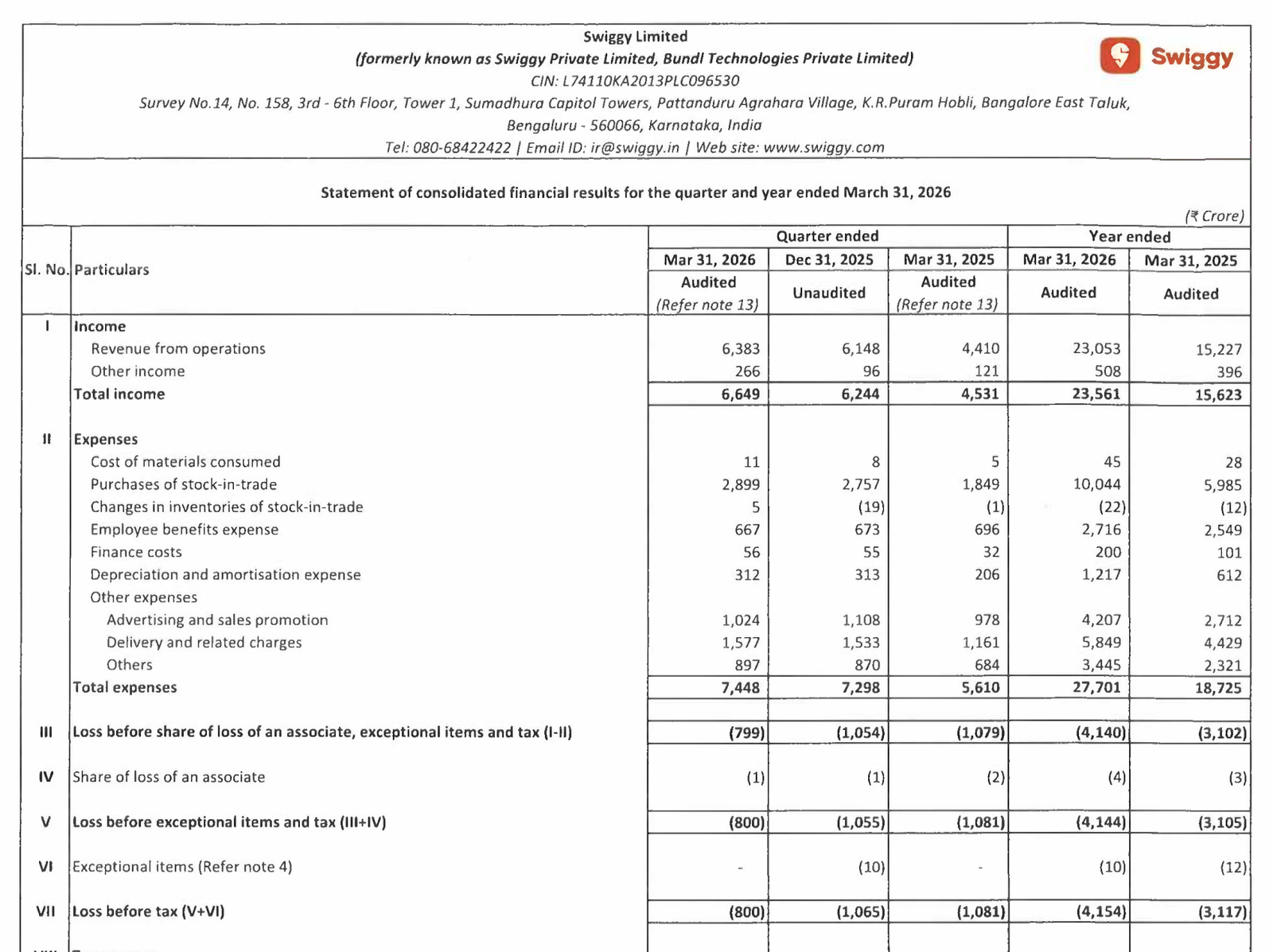
Margin Analysis
Drivers:
- Higher quick-commerce scale supported revenue expansion.
- Delivery and logistics expenses remained elevated.
- Employee benefit expenses and depreciation continued to pressure margins.
- Finance costs increased due to business scaling and infrastructure expansion.
- Advertising and sales promotion expenses remained high for customer acquisition.
Insight:
- Operational scale is improving, but profitability remains under pressure because growth investments are still significantly ahead of margin stabilization.
Segment performance
Segments: Food Delivery
- Revenue: ₹2,073 crore
- Revenue grew steadily due to higher order volumes and improved user engagement.
- Segment profit improved substantially YoY.
Segments: Out of Home Consumption
- Revenue: ₹107 crore
- Continued expansion from a smaller base.
- Segment turned profitable operationally.
Segments: Quick Commerce
- Revenue: ₹1,057 crore
- Strong YoY growth driven by Instamart expansion and dark-store scaling.
- Segment losses remained high due to aggressive customer acquisition and operational expansion.
Segments: Supply Chain & Distribution
- Revenue: ₹3,135 crore
- Became the largest revenue contributor among business verticals.
- Revenue growth remained strong due to FMCG and retail distribution partnerships.
Segments: Platform Innovations
- Revenue: ₹11 crore
- Includes Swiggy Genie, Minis, Snacc, Sports, and other incubating initiatives.
- Business remains investment-heavy with limited monetization currently.
Segment insight
Segment Commentary:
- Swiggy’s business mix is increasingly diversifying beyond food delivery. Quick commerce and supply chain distribution are becoming major growth engines, while food delivery continues to provide operational stability and contribution support.
Key Characteristics:
- Quick commerce remains the largest drag on profitability.
- Food delivery business is showing improving operating leverage.
- Supply chain distribution is emerging as a high-scale revenue vertical.
- Platform innovation businesses remain in incubation mode.
- Revenue diversification reduces dependency on a single business line.
Earning quality check
Key Drivers:
- Strong top-line growth across all major verticals.
- Improved scale efficiencies in food delivery.
- Higher contribution from supply chain and logistics operations.
- IPO-related and expansion-related operational investments impacted profitability.
- Employee stock option costs continued to affect earnings quality.
Interpretations:
- Revenue quality appears strong due to diversified business growth, but earnings quality remains weak because profitability still depends heavily on future operating leverage improvements.
balance sheet Analysis
- Total Assets: ₹25,237 crore
- Total Liabilities: ₹6,923 crore
Insight:
- Swiggy’s balance sheet strengthened materially post capital raise and IPO funding.
- Cash balances and investments increased significantly, providing strong liquidity to fund future expansion and operating losses.
Cash flow analysis
Operating Cash Flow:
- Net cash used in operating activities stood at ₹2,898 crore.
- Operating cash burn increased due to working capital requirements and expansion costs.
Investing Cash Flow:
- Net cash used in investing activities stood at ₹4,983 crore.
- Significant investments were made into investments, infrastructure, and business expansion.
Financing Cash Flow:
- Net cash generated from financing activities stood at ₹9,397 crore.
- Fresh issue proceeds from equity shares significantly strengthened liquidity.
Final Cash Position:
- Closing cash and cash equivalents stood at ₹2,747 crore versus ₹1,231 crore last year.
key risks
- Persistent losses in quick-commerce operations.
- Intense competition from Zomato, Blinkit, Zepto, and Amazon.
- Rising delivery and logistics costs.
- Customer acquisition spending may remain elevated.
- Regulatory scrutiny in gig economy and food delivery ecosystem.
- Execution risks in scaling new business verticals.
management strategy signals
Focus Area:
- Scaling quick commerce aggressively.
- Improving food delivery profitability.
- Expanding supply chain and distribution partnerships.
- Building ecosystem-based platform services.
- Investing in technology, dark stores, and logistics infrastructure.
Financial metrics table
| Particular | Q4 FY26 | Q.O.Q | Y.O.Y |
|---|---|---|---|
| Total Income | ₹6,649 Crore | +6.49% | +46.75% |
| PBT | ₹-800 Crore | +24.88% Improvement | +26.00% Improvement |
| PAT | ₹-800 Crore | +24.88% Improvement | +26.00% Improvement |
Swiggy delivered another quarter of strong revenue expansion led by quick commerce, food delivery, and supply chain operations. While operational scale continues to improve, profitability remains a major challenge due to aggressive growth investments and competitive intensity.
The company now possesses a significantly stronger balance sheet post capital raise, giving it the ability to continue scaling aggressively over the coming years.
Official Exchange Filing: Swiggy Limited
FISCAL YEAR
2025-2026
AUDIT STATUS
REVIEWED